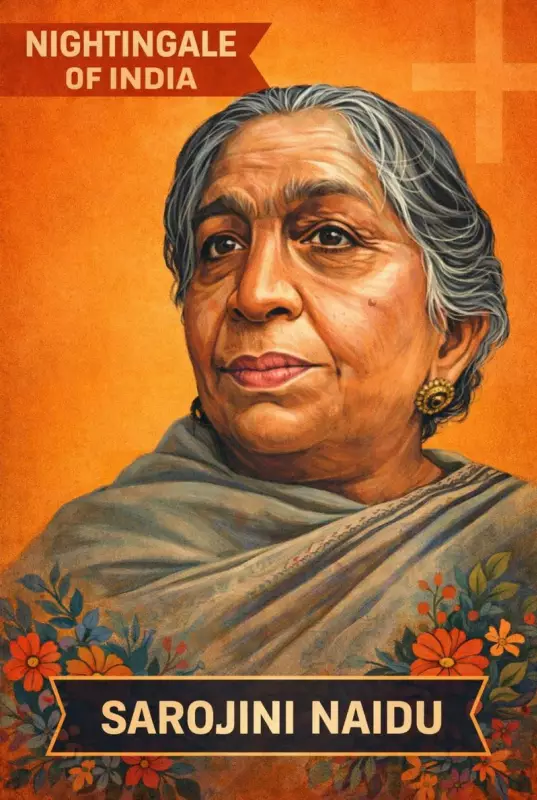
Sarojini Naidu stands as one of the most luminous and multifaceted figures in the history of India's struggle for independence. More than just a political leader, she was a celebrated poet, a gifted orator, and a tireless social reformer whose life's work wove together the threads of art and activism. Known affectionately as the 'Nightingale of India' (Bharat Kokila) for her mellifluous poetry in English, she used her powerful voice not just to create beauty but to rally a nation towards the dream of Swaraj.
From Prodigy to Political Powerhouse
Born on February 13, 1879, in Hyderabad, Sarojini Chattopadhyay displayed extraordinary intellectual gifts from a young age. She mastered multiple languages and wrote her first major poetic work, 'The Lady of the Lake,' at just twelve. Her academic prowess took her to England, where she studied at King's College, London, and later Girton College, Cambridge. It was during these formative years that her literary talents flourished, earning encouragement from eminent figures like Arthur Symons and Edmund Gosse.
However, her return to India marked a pivotal turn. The partition of Bengal in 1905 and the growing wave of nationalist sentiment stirred her soul. She transformed from a poet of romantic verses to a poet-prophet of patriotism. Her encounter with Gopal Krishna Gokhale in 1906 became the catalyst, with him urging her to dedicate her genius to the motherland. She heeded the call, plunging into the political fray and soon becoming a prominent leader within the Indian National Congress.
A Pillar of the Freedom Movement
Sarojini Naidu's political career was marked by fearless dedication and strategic brilliance. She forged a deep and abiding association with Mahatma Gandhi, whom she affectionately called 'Mickey Mouse,' and became an indispensable ally in his campaigns. She played a crucial role in the aftermath of the Jallianwala Bagh massacre, assisting in the Congress inquiry and offering solace.
Her leadership was truly tested during the Civil Disobedience Movement and the Salt Satyagraha. When Gandhi was arrested in 1930, Naidu took command of the protest at the Dharasana Salt Works, displaying immense courage in the face of potential violence. This act solidified her reputation as a leader of immense fortitude. Her political journey reached a historic milestone in 1925 when she was elected as the first Indian woman President of the Indian National Congress in Kanpur.
Poetry as a Weapon and a Balm
While her political work was formidable, her poetic legacy remains equally profound. Collections like 'The Golden Threshold' (1905), 'The Bird of Time' (1912), and 'The Broken Wing' (1917) captured the spirit of India—its beauty, its sorrow, and its awakening pride. Poems such as 'In the Bazaars of Hyderabad' vividly painted Indian life, while 'The Gift of India' poignantly honored Indian soldiers who fought in World War I, simultaneously appealing for India's own freedom.
Her poetry was never separate from her politics; it was the medium through which she communicated the soul of the independence movement to India and the world. It served as both a weapon against oppression and a balm for a struggling people.
Legacy of a Trailblazer
After India gained independence in 1947, Sarojini Naidu was appointed as the first woman Governor of the United Provinces (present-day Uttar Pradesh), a role she served with distinction until her passing. She died on March 2, 1949, in Lucknow, leaving behind a legacy that transcends any single field.
Sarojini Naidu's life demonstrates the powerful synergy of culture and revolution. She was a woman who broke barriers in a male-dominated political sphere, advocated for women's rights and Hindu-Muslim unity, and proved that the pen and the protest could be equally mighty. The Nightingale's song was not merely one of beauty, but a clarion call that helped sing a nation into existence. Her story continues to inspire, reminding us that the fight for freedom and justice can be waged with both unwavering resolve and profound artistic grace.