Supreme Court Dismisses Telangana's Challenge to Andhra's Polavaram Project Expansion
The Supreme Court has dismissed a writ petition filed by Telangana against the Union government and Andhra Pradesh. The petition challenged the proposed expansion of the Polavaram-Banakacherla Link Project. The bench, comprising Chief Justice of India Surya Kant and Justice Joymalya Bagchi, made this decision on Monday, January 12.
Court's Observations on the Dispute
The court observed that the dispute primarily concerns water resources. It stated the matter should be addressed under the Inter-State Water Disputes Act of 1956. The bench called the petition "prima facie not maintainable". However, it allowed Telangana to pursue other legal remedies.
The Contentious Polavaram Irrigation Project
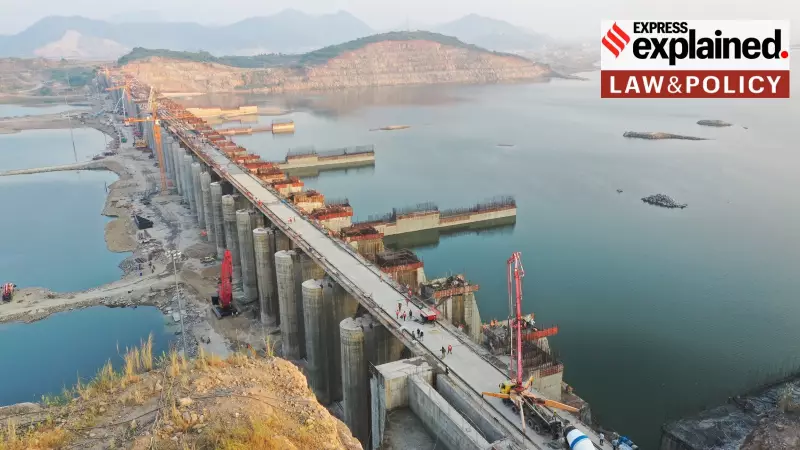
Andhra Pradesh's Polavaram Irrigation Project is a major initiative on the Godavari River. The river originates in the Western Ghats, flows through Maharashtra, and empties into the Bay of Bengal. Approved in 2009, the project was permitted to divert 80 TMC of water from the Godavari to the Krishna River.

This diversion aims to benefit the Krishna Delta. The project operates under the Godavari Water Disputes Tribunal Award and clearances from the Central Water Commission.
Telangana's Objections to the Expansion
Telangana alleges that Andhra Pradesh has exceeded the original 80 TMC limit. The state claims project infrastructure now carries over 200 TMC of water, with plans to increase it to 300 TMC. This expansion is part of the Polavaram-Banakacherla Link Project, also known as the Polavaram-Nallamalasagar Link Project.
Andhra Pradesh maintains it only uses "flood" or "surplus" waters from the Godavari. Telangana, however, points to significant physical changes. The Right Main Canal is being widened from 12,254 cusecs to 35,500 cusecs. Twin tunnels are having their capacity doubled from 20,000 to 40,000 cusecs.
Telangana argues these modifications enable much larger and sustained diversions. The state withdrew its petition after the bench noted Karnataka and Maharashtra were not included as parties. Telangana can still institute a suit involving all affected basin states.
Legal Framework for Interstate Water Disputes
India resolves interstate river disputes under the Inter-State River Water Disputes Act of 1956. When states fail to agree on water sharing, the Union government can form a tribunal. The tribunal's award is final and binding, with the force of a Supreme Court decree.
The Krishna Water Disputes Tribunal and Godavari Water Disputes Tribunal were constituted in 1969. They addressed prolonged disputes among Maharashtra, Karnataka, and Andhra Pradesh. These tribunals quantified available water using a "75% dependability" standard and allocated specific shares to each state.
Two key clauses are central to the current dispute:
- Clause IV of the GWDT Award allows states to divert their allocated Godavari waters to another basin. Andhra Pradesh cites this to justify transfers to the Krishna.
- Clause XIV(B) of the KWDT Award, the "augmentation clause", places conditions on such diversions. It states that if Krishna waters are augmented by diversion from another river, no state can be prevented from claiming a proportionately larger share.
This means upper-riparian states like Karnataka and Maharashtra can demand more Krishna water if Godavari water is added. Karnataka has already invoked this clause to claim up to 112 TMC of Krishna water.
Telangana's Legal Arguments and Concerns
Telangana approached the Supreme Court under Article 32 of the Constitution. The state argued the dispute is about enforcing existing tribunal awards and statutory safeguards, not reopening water allocation.
Key points from Telangana's case include:

- The Andhra Pradesh Reorganisation Act of 2014 declares Polavaram a national project. Section 90 places its regulation under Union government control. Telangana argues only the Centre or the Polavaram Project Authority can propose modifications.
- The state invokes Article 21, stating unauthorized diversion deprives residents of river water, affecting drinking supply, irrigation, and livelihoods.
- It cites Article 300A, arguing water allotted under tribunal awards is a legal entitlement. Andhra Pradesh's expansion takes this share without legal authority.
Beyond allocation, Telangana raises concerns about submergence and safety. Unauthorized expansion alters Polavaram reservoir operation. Holding the reservoir at higher levels for longer periods during monsoon causes drainage congestion. Local streams cannot discharge into the river, leading to prolonged inundation.
Areas like Bhadrachalam Temple town, the Manuguru Heavy Water Plant, and several villages face risks from these sustained changes. The Supreme Court's dismissal shifts the focus to potential future legal actions under the water disputes framework.