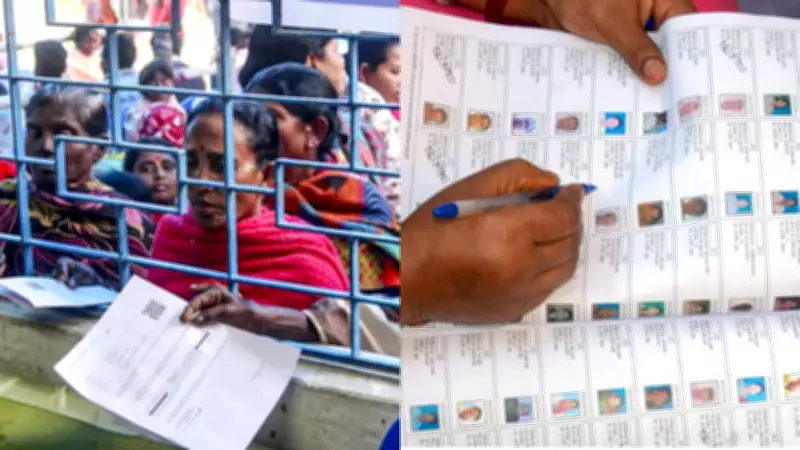
The Supreme Court on Wednesday held that the Election Commission of India (ECI) acted within its statutory powers while conducting the Special Intensive Revision (SIR) of electoral rolls in Bihar. The court ruled that the exercise could not be termed ultra vires merely because it differed from the ordinary revision process.
Court's Ruling on Proportionality
The apex court stated that the SIR fulfills proportionality and is not manifestly excessive. It was founded on the constitutional purpose of restoring accuracy to electoral rolls. The measures adopted by the ECI cannot be held disproportionate, the court said, according to Live Law.
Calling the controversial roll revision legally tenable, the top court said the EC did not violate the Representation of People Act (RPA) by ordering the Special Intensive Revision of Bihar electoral rolls, as such an exercise ensured the purity of electoral rolls and aided in free and fair elections.

Bench and Verdict Details
A Bench led by Chief Justice of India Surya Kant and Justice Joymalya Bagchi pronounced the verdict on Wednesday after reserving judgment in January following extensive hearings. The Supreme Court, however, clarified that the poll body cannot determine the citizenship of a voter. The court said that the determination of citizenship by the election commission for inclusion in the voter list is not final, as it must be thoroughly examined by the Union government after giving adequate opportunity to the doubtful voter who is deleted from the electoral roll.
Background of the Petitions
The petitions had challenged the legality of the SIR exercise, arguing that the process exceeded the powers granted to the poll body under Article 326 of the Constitution, the Representation of the People Act, 1950, and the rules framed under it. The dispute largely centered on the ECI's requirement that voters whose names did not appear in the 2002 electoral rolls, or the 2003 rolls in certain states, must prove ancestral linkage to a person whose name featured in those electoral records.
Petitioners argued that this condition risked disenfranchising genuine voters, especially marginalized and migrant communities who often lacked documentary evidence tracing their ancestry to older electoral rolls.
Interim Directions and Document Verification
During the hearings, the Supreme Court issued interim directions aimed at improving transparency and reducing hardship for voters affected by the SIR exercise across several states and union territories. The poll body had initially listed 11 documents for verification. However, the apex court later directed that Aadhaar also be accepted as an additional document for the SIR process.
Most petitions were filed in June last year after the ECI initiated the SIR exercise in Bihar. The revision process was later extended to several other states and union territories, including West Bengal, Kerala, and Tamil Nadu.
ECI's Defense and Verdict Reservation
Defending the exercise before the apex court, the ECI maintained that the revision was necessary to preserve the purity of electoral rolls and prevent duplication or the inclusion of ineligible voters. After hearing all parties at length, the Bench headed by CJI Surya Kant reserved its verdict on January 29.
The Supreme Court's decision upholds the ECI's authority to conduct such revisions to maintain accurate electoral rolls, while emphasizing that citizenship determination remains with the Union government.