

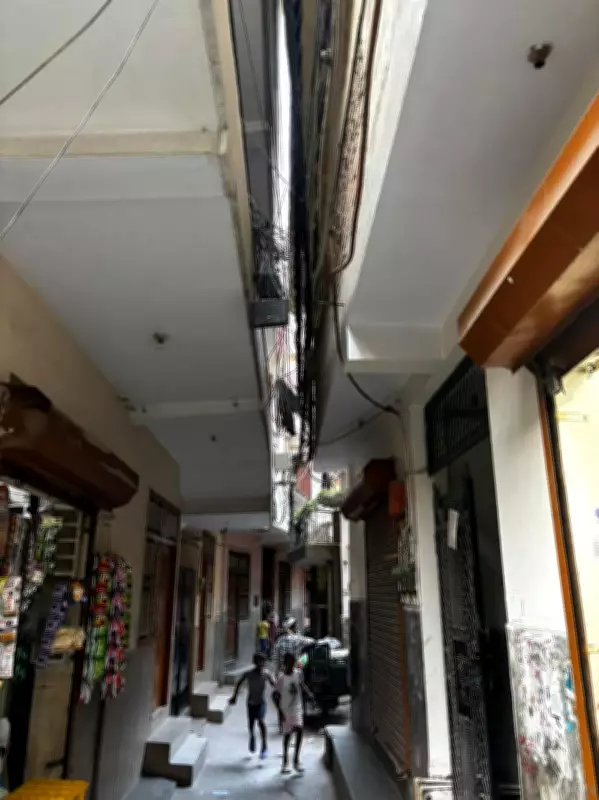
Student Hubs in South Delhi Face Fire Safety Risks Due to Narrow Lanes
In the congested lanes of Munirka, Ber Sarai, and Katwaria Sarai villages in South Delhi, sunlight barely reaches the ground. Buildings have risen floor after floor in unchecked vertical growth, electrical wires hang overhead, and commercial activity spills into streets originally designed for small settlements. These areas, home to thousands of students studying in Delhi, have become some of the most budget-friendly accommodation hubs in the capital. However, residents and officials warn that the very features making these localities affordable and convenient could turn them into death traps if a major fire breaks out.
Ground Report: Narrow Lanes and Overcrowding
A ground visit to these three urban villages revealed lanes so narrow that even pedestrians struggle to move through some stretches. Multi-storey buildings stand shoulder to shoulder, often with no space between them. Entry points are crowded, and several lanes are lined with parked vehicles, utility poles, and overhead cables. The situation is particularly concerning due to the large student population living in these areas because of their proximity to institutions such as the Indian Institute of Technology-Delhi, Jawaharlal Nehru University, Indian Institute of Foreign Trade, Indian Institute of Mass Communication, and Sanskrit University. Many students acknowledged the risks but said the comparatively low cost of accommodation leaves them with limited options.
Rapid Commercialisation and Fire Hazards
The neighbourhoods have undergone rapid commercialisation over the years. Small eateries, grocery shops, and other businesses catering to students operate throughout the day. In Munirka, the furniture market adds another layer of concern because of the large quantities of wood, foam, and upholstery material stored in shops. Several residential buildings have been converted into rental properties, with local residents claiming that a significant number of owners no longer live in the area. They instead rent out entire buildings to students and working professionals. The biggest concern, however, is what may happen if a fire breaks out.

Fire Department Admits Challenges
AK Malik, Deputy Chief Fire Officer of the Delhi Fire Services, admitted that emergency response in such localities becomes difficult. "Yes, there is no chance that a fire vehicle can enter many of these areas. It would be a challenge for firefighters to carry out rescue operations because of the narrow streets. We would have to arrange gauze setup which is at times a time-taking procedure causing an extra delay in emergency responses. Apart from this, electricity poles and hanging wires across these lanes could also become a hurdle during emergency response," the senior officer said. His assessment reflects fears long expressed by residents who believe that evacuation, rather than firefighting, would become the biggest challenge during a major emergency.
Residents Voice Concerns
Among them is 71-year-old Atar Singh, a lawyer and lifelong resident of Munirka. "Though there has not been a major fire here, if it happens, it will be a disaster like never before," Singh said. Describing how the locality changed over the decades, he said, "This place existed as a village of Delhi. It was never meant to be a commercial space where people would make money from rentals and businesses. The main issue is that most people do not have proper land records. Legal possession exists only for those whose land falls under the Lal Dora limits of the village. Much of the remaining land was government land that is now occupied by people." Other residents say the transformation of these villages into densely populated student and commercial hubs happened far faster than the supporting infrastructure could handle.

Allegations of Encroachment and Ignored Orders
Questions have also been raised over encroachments and enforcement. Bharat Singh, secretary of the Munirka Welfare Association, said residents had approached the Delhi High Court a few years ago seeking action to clear access routes. "We filed a petition in the Delhi High Court a few years ago, following which directions were issued to departments and authorities concerned to clear the entry points of Munirka. However, those orders were completely ignored," he alleged. He further alleged that "the building authorities, MCD and even the Delhi Police receive money on a monthly basis from people violating rules. That is why these violations continue despite complaints." The allegations could not be independently verified. Residents point to encroachments, unauthorised construction, and shrinking access routes as factors that have steadily reduced emergency access into the localities. What were once village lanes are now crowded corridors accommodating thousands of tenants, paying guests, shops, and businesses.
A Question of Survival
For now, life continues uninterrupted. But behind this lies a question that neither residents nor officials appear able to dismiss: if a fire breaks out deep inside these neighbourhoods, how will people get out and how will rescuers get in?





