

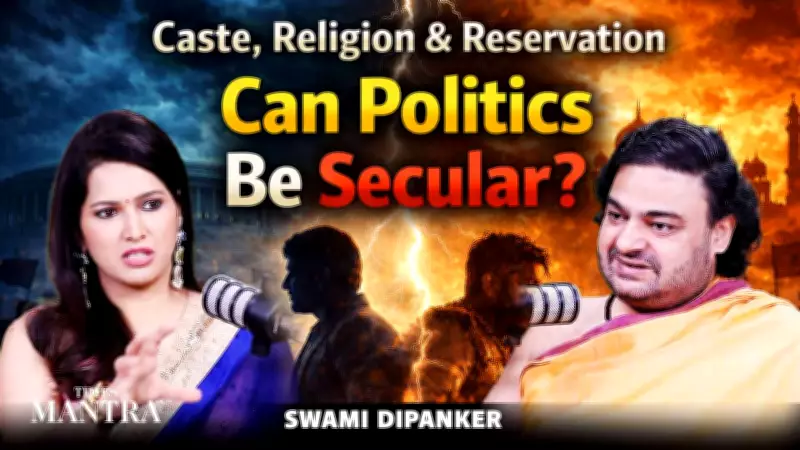
Swami Dipanker Examines the Deep-Seated Challenges to Secular Politics in India
In a compelling and insightful discussion, Swami Dipanker has brought to light the profound complexities surrounding secular politics in India, a nation deeply influenced by caste, religion, and reservation systems. The conversation, originally featured on TOI.in on April 10, 2026, explores whether true political secularism is achievable in such a diverse and historically layered society.
The Interplay of Caste, Religion, and Reservation in Political Decisions
Swami Dipanker provides deep insights into how caste, religion, and reservation policies significantly shape political decisions and societal structures in India. He argues that these factors are not merely peripheral issues but central to the functioning of the political landscape, often dictating electoral strategies and policy formulations.
The discussion raises critical questions about equality and identity, challenging the very notion of secularism as it is practiced today. Is it possible for politics to remain neutral when identity-based considerations are so deeply entrenched? Swami Dipanker suggests that the ideal of secularism might be more aspirational than practical, given the country's socio-political realities.

Questioning the Feasibility of True Neutrality in Politics
One of the key points highlighted in the conversation is the debate over whether true neutrality in politics is even attainable. Swami Dipanker delves into the idea that secularism, in its purest form, requires a detachment from religious and caste-based influences, which may be challenging in a context where these identities are integral to personal and community life.
The exploration extends to how reservation policies, intended to address historical injustices, further complicate the secular framework. These policies, while aimed at promoting social justice, often become politicized, leading to tensions and debates that question the balance between equity and identity politics.
Implications for Indian Society and Future Debates
Swami Dipanker's insights shed light on the broader implications for Indian society, emphasizing the need for ongoing dialogue and reflection. The conversation underscores that issues of caste, religion, and reservation are not just political tools but are deeply woven into the social fabric, affecting everything from governance to everyday interactions.
This discussion is particularly relevant in today's context, where identity politics and policy debates continue to evolve. It invites viewers and readers to critically assess the state of secularism in India and consider whether current approaches are sufficient or if new paradigms are needed to foster a more inclusive and equitable political environment.
By engaging with these complex topics, Swami Dipanker encourages a deeper understanding of the challenges and opportunities in achieving a truly secular polity, making this a vital contribution to contemporary political discourse in India.






