

Tamil Nadu's Six-Decade Policy Failure Endangers Vital Elephant Corridors in Nilgiris
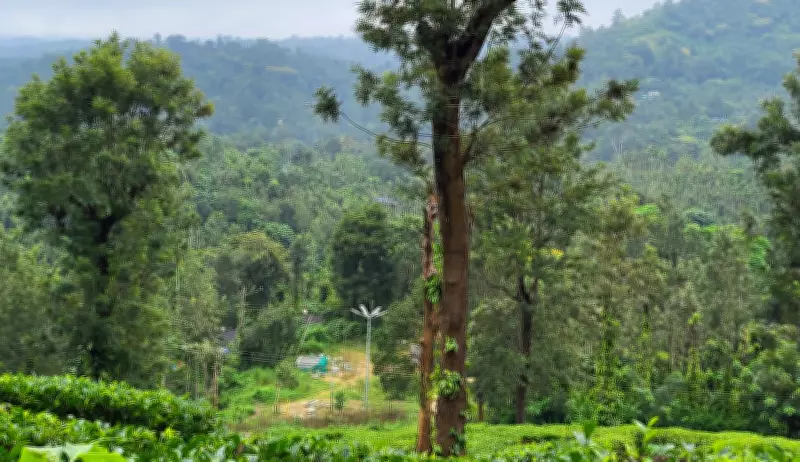
The Tamil Nadu government's prolonged delay in implementing Section 17 of the Gudalur Janmam Estates (Abolition and Conversion into Ryotwari) Act, 1969, has persisted for approximately six decades, leading to extensive encroachments across the region. This includes significant intrusions along crucial elephant corridors in O'Valley, located within the Gudalur taluk of the Nilgiris district.
Critical Ecological Corridor Under Threat
Gudalur serves as an essential elephant corridor connecting Wayanad in Kerala and the Mudumalai Tiger Reserve in Tamil Nadu. However, this vital passageway is experiencing fragmentation due to unchecked encroachments, developmental activities, and escalating conflicts between humans and elephants. Environmentalists emphasize that the janmam lands span over 80,000 acres in the Nilgiris, encompassing ecologically sensitive shola forests that are a crucial component of the Western Ghats biodiversity hotspot.
"It is described as the 'overhead water tank' for half the country," says V Sivadas, managing trustee of the Nilgiris-based environmental organization Nest. "Due to deforestation and encroachments, forest cover in the Nilgiris has shrunk to 20% of its original area."

Legal Ambiguity and Political Paralysis
A central issue revolves around the classification of janmam land, previously owned by janmis (landlords), as either 'forest land' for government ownership or 'ryotwari land' for private ownership via pattas. Out of the 80,000 acres of janmam land in Gudalur, roughly 50,300 acres had been leased out by the janmis. By the time the Act was enforced in 1969, nearly 15,000 acres of rainforest had already been converted into plantations.
Plantation companies and individuals have asserted claims as leaseholders or tenants, complicating the settlement process. "Political parties make promises during elections regarding these issues, but they remain unresolved after votes are polled," notes R Sathyaseelan, an activist from O'Valley. While the Act provides the government with authority to manage leased plantation lands and offers a legal framework for legitimate occupants to obtain land rights, ongoing legal disputes over land classification have hindered the provision of basic amenities and infrastructure in areas designated as 'Section 17 lands,' facilitating further encroachments.
Mounting Legal Battles and Environmental Impact
According to the district office of survey and settlement (DOSS), approximately 35,000 acres of Janmam land, primarily in O'Valley, remain under Section 17. "These lands are used by 11 major and 82 smaller estates for tea cultivation. About 300 cases related to these lands, including those involving encroachments, are pending before Madras high court and about three before Supreme Court," reveals a DOSS official who requested anonymity.
Forest officials warn that human-elephant conflict is a growing concern that can only be mitigated by formally notifying and protecting the corridors. "As encroachments continue, the likelihood of conflict is likely to increase. Elephants tend to return to their traditional routes despite barriers," they state.
Historical Context and Ongoing Challenges
"The janmam land conflict is one of India's longest-running policy failures," asserts Siddhartha Krishnan, an environmental sociologist and historian whose PhD thesis focused on this issue. "The DMK government of the day displayed intent in abolishing the janmam tenure. It should have simply assumed control of janmi leases to plantations. But in section 17 of the Act, the rider that the 'government may, if in their opinion, it is in the public interest to do so, by notice given to the person concerned, terminate the rights' created by the janmi, in retrospect, suggests policy uncertainty. This legal ambiguity has perpetuated a policy paralysis."

In January 2025, Chief Minister M K Stalin convened a meeting to review Section 17 and the necessity to take over 34,986 acres in Gudalur where leases have expired. Lawyers clarify that the Act was passed in 1969, took effect in 1974, and pattas under other sections (8, 9, and 10) were granted by 1978. Section 17, however, remains in limbo. The legislation mandates the government to terminate leases, take possession of the land, and compensate lessees if required. Yet, this action has not been executed despite leases having lapsed.
Widespread Encroachments and Systemic Issues
Numerous lessees occupy the land without paying rent or taxes while seeking pattas by asserting tenant status. The law prohibits corporate entities from receiving ryotwari pattas, which are intended for individuals cultivating annual crops. Despite court rulings upholding the Act, encroachers have persistently filed appeals.
"Large-scale encroachments continue unchecked, with some individuals building houses on several acres of land without approval. Estate owners have encouraged small-scale encroachments to protect their interests," explains S Anandaraja, secretary of the South India Repatriates Development Association. "Some encroachers have built buildings on 10 acres of encroached land. How is it possible without the complicity of local officials? All of the encroachers' houses have electricity connections and water supply." Despite multiple attempts, the district settlement officer could not be reached for comment.
Key Statistics and Unresolved Classification
- Unfinished Classification: When the Act was implemented in 1974, the government assumed the role of lessor from Nilambur Kovilagam and took over about 80,000 acres of Janmam land. Of this, around 45,000 acres were classified under sections 8, 9, 10, 11, 14, 15, and 53, while nearly 35,000 acres under Section 17 were left unclassified.
- Corporate Control: Eleven major plantations held more than 80% of the leased forest area of 50,300 acres. Several companies have sought pattas claiming long possession. Among them, Birla, a Section-17 lessee in O'Valley, possessed almost 40% of the leased lands and more than half the private forests. Hindustan held 11% of the leased land and 9% of the private forest area. Most leases expired between the 1970s and 2010, but the lands were not taken over.
- Encroachments: More than 10,000 families, including those from ST, SC, MBC, and BC communities and Sri Lankan refugees, have encroached on 300 acres for housing and 4,900 acres for cultivation, totaling over 5,000 acres under Section 17. According to a 2021 statement by Forest Minister K Ramachandran, the legal status of the land remains unchanged, but encroachments have likely increased.
- Hanging in the Balance: More than 16,000 families in the region struggle for basic amenities such as electricity; O'Valley, an elephant corridor, remains entirely under leasehold, exacerbating environmental and social tensions.
