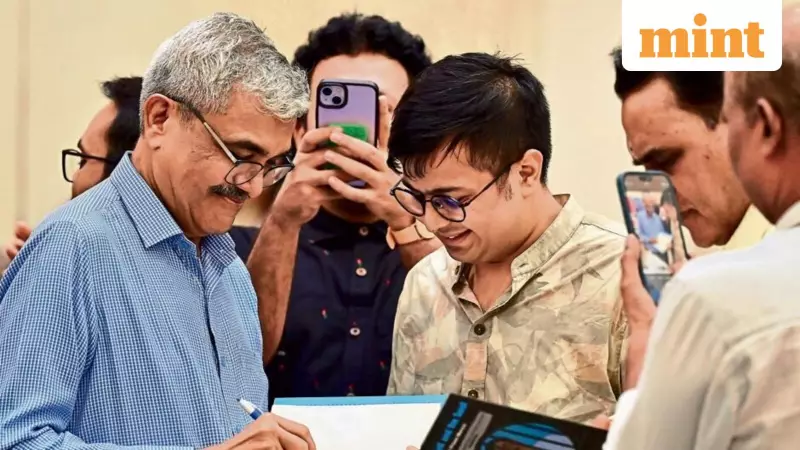
Dalit scholar and management professor Anand Teltumbde released two significant books in quick succession towards the end of last year. The first, The Cell and the Soul, published by Bloomsbury India, is a stark memoir detailing his over two-year incarceration as an undertrial. The second, The Caste Con Census from Navayana, offers a historical and critical analysis of the intensely debated caste census. Teltumbde, a graduate of the prestigious Indian Institute of Management, Ahmedabad, was a professor at the Goa Institute of Management until his arrest in 2020. He faced allegations of involvement in the 2018 Bhima Koregaon violence and was finally granted bail in 2022.
Writing from Behind Bars: The Personal and Political Merge
In an interview, Teltumbde explained the genesis of his prison memoir. He revealed he had no deliberate plan for the book but was determined to document his experiences if he ever got out. "I had gone with a preparation to die there," he stated. Upon realizing he could read and write in jail, he began making notes, ultimately shaping the book from 22 of roughly 100 such fragments.
He described prison as a place that imposes clarity, stripping away routine and mobility. "You are left with only two things: your mind and the system that seeks to crush you," Teltumbde said, noting that under such conditions, the personal and political become inseparable. The book, he argues, is not merely personal because every inmate's experience is molded by the power hierarchies and systemic violence inherent in the institution.

Prison as Society's Magnifying Glass
Teltumbde draws powerful parallels between life inside prison and the constraints of free society. He views prison as a "concentrated form of control," similar to the ambient surveillance in society through CCTV and digital footprints. While prison walls physically restrict movement, societal mobility is limited by class, caste, gender, and geography.
"Most people are free, but only within the narrow boundaries the social location allows," he observed. He further equated the arbitrariness of prison authorities, who act like lords in an opaque system, with the hidden arbitrariness in society masked by bureaucratic procedures, laws, and market forces.
Class Over Caste: The Jail Hierarchy
Addressing power dynamics within prison, Teltumbde challenged the notion that caste is the primary divider. While he acknowledged instances of guards identifying him as Dalit, he did not personally witness caste determining menial tasks. Instead, he found that class and wealth formed the core hierarchy.
"Whosoever has money automatically becomes a Brahmin," he explained, citing gangsters who buy influence with authorities and fellow inmates by distributing canteen goods. Murderers, he noted, are often seen as macho, while rapists and those under the POCSO Act are stigmatized. Political prisoners like himself were respected as oddities.
The Caste Census Conundrum and a 'Terrorised' Civil Society
Shifting to contemporary politics, Teltumbde expressed a grim view of resistance, suggesting civil society has been "terrorised to normalcy" through exemplary arrests, like those in the Bhima Koregaon case and more recently, climate activist Sonam Wangchuk. He sees the opposition as dead and the country driven into a dead end.
On caste, he argued that discrimination is worsening, fueled by a neoliberal economic order that has pushed all rural castes into crisis. The loss of traditional privileges for dominant castes, coupled with a lack of jobs, has led to resentment and a scramble for reservation benefits. "There is no caste which has not demanded reservation," he pointed out.
This crisis, he says, manifests as a demand for a caste census—a reaction to vast wealth inequality. However, Teltumbde is critical of the census exercise. He predicts upper castes will opt out to avoid exposing the link between their caste and accumulated wealth. More importantly, he questions its utility.

"Data does not automatically do anything... There has to be political will," he asserted, asking if any government would use the data for radical wealth redistribution or land reform, rather than just representation. For him, the debate is not about data but the ethics of further entrenching caste identities in politics.