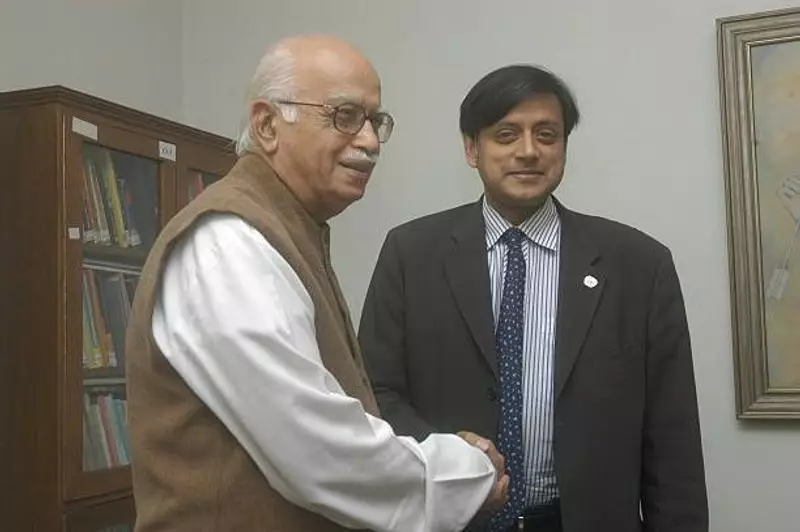
Senior Congress leader Shashi Tharoor has made a significant statement regarding veteran BJP politician LK Advani, suggesting that his entire political career should not be judged solely by the Babri Masjid demolition episode. The remarks came during discussions about Advani recently receiving the Bharat Ratna, India's highest civilian award.
Political Crossroads: Tharoor's Unconventional Stand
In what many are calling an unexpected position from a Congress leader, Tharoor emphasized that Advani's decades of public service cannot be reduced to a single controversial moment. The three-time MP from Thiruvananthapuram acknowledged the complexity of evaluating political legacies, particularly when they span multiple decades and contain both commendable and controversial chapters.
Tharoor specifically addressed the 1992 Babri Masjid demolition, an event that fundamentally altered India's political landscape and communal dynamics. While not condoning the incident, he argued that assessing a politician's entire career requires looking beyond individual episodes, no matter how significant they might be.

Historical Context and Political Reactions
The timing of Tharoor's comments is particularly noteworthy, coming shortly after the Bharat Ratna announcement for Advani in February 2024. The award recognition sparked nationwide debate about how political figures should be evaluated and what constitutes worthy service to the nation.
Within political circles, reactions to Tharoor's statement have been mixed. Some colleagues from his own party have expressed discomfort with what they perceive as softening criticism of a political opponent associated with one of post-independence India's most divisive events. Meanwhile, BJP leaders have welcomed what they see as a more nuanced approach to political discourse.
LK Advani's political journey spans over seven decades, during which he served as Home Minister, Deputy Prime Minister, and was instrumental in shaping the BJP into a national political force. His Rath Yatra in 1990 remains one of the most significant political movements in modern Indian history, fundamentally altering the country's political discourse.
Broader Implications for Indian Politics
Tharoor's comments raise important questions about how political legacies are constructed and evaluated in India. They suggest a potential shift toward more balanced historical assessment of political figures, acknowledging both their contributions and controversies without letting either completely define their legacy.
The discussion comes at a time when Indian politics is increasingly polarized, with historical figures often being either glorified or vilified without much middle ground. Tharoor's approach, while controversial within his own party, represents an attempt to introduce more nuanced political discourse in the country.
As India continues to grapple with its complex history and evolving political culture, statements like Tharoor's highlight the ongoing tension between political loyalty and historical objectivity. They also demonstrate how individual politicians sometimes transcend party lines in their assessment of historical events and figures.
The conversation around Advani's legacy and the Bharat Ratna award continues to evolve, with Tharoor's comments adding an unexpected dimension to what might otherwise have been a predictable political debate along established party lines.