

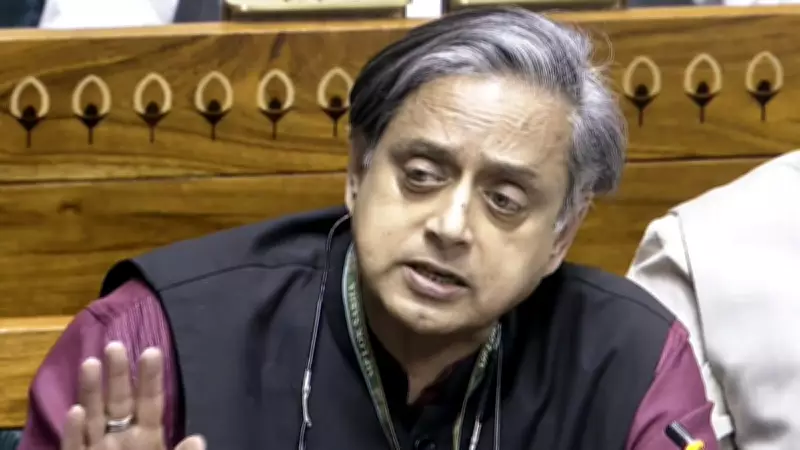
Congress MP Shashi Tharoor has sparked a fresh political controversy by describing the rendition of the full version of Vande Mataram at official events as 'unnecessary and burdensome'. The remarks drew an immediate and sharp response from the Bharatiya Janata Party (BJP), which accused Tharoor of disrespecting the national song.
Tharoor's Remarks
Speaking at an event, Tharoor questioned the practicality of singing all stanzas of Vande Mataram, composed by Bankim Chandra Chatterjee, at government functions. He argued that the practice could be time-consuming and may not be feasible in a diverse country like India. 'The full version of Vande Mataram is long and not everyone knows all the verses. Making it mandatory at official events seems unnecessary and burdensome,' Tharoor said.
BJP's Counterattack
The BJP was quick to condemn Tharoor's statement. Party spokesperson Sambit Patra said, 'Vande Mataram is not just a song; it is the soul of our nation. Tharoor's comments reflect a colonial mindset and a lack of respect for India's cultural heritage.' Several other BJP leaders also took to social media to criticize the Congress leader, accusing him of trying to undermine national pride.

Historical Context
Vande Mataram, written in the late 19th century, played a crucial role in India's freedom movement. It was adopted as the national song in 1950. The full version consists of six stanzas, though usually only the first two are sung at public events. The debate over its mandatory rendition has resurfaced periodically, with some arguing that it promotes Hindu nationalism, while others see it as a unifying symbol.
Political Reactions
The Congress party distanced itself from Tharoor's remarks, with a spokesperson saying that the party respects all national symbols. However, Tharoor's comments have reignited the debate on the role of religious and cultural symbols in a secular state. Political analysts suggest that this controversy could impact the ongoing electoral campaigns, especially in states where national identity is a key issue.
Conclusion
As the war of words continues, Tharoor has not issued any clarification or apology. The BJP has demanded that he retract his statement and apologize to the nation. The incident highlights the deep political divide over the interpretation of national symbols in contemporary India.






