Tharoor Snubs Congress, Skips Key Meeting; Zelensky Announces First US-Russia-Ukraine Talks
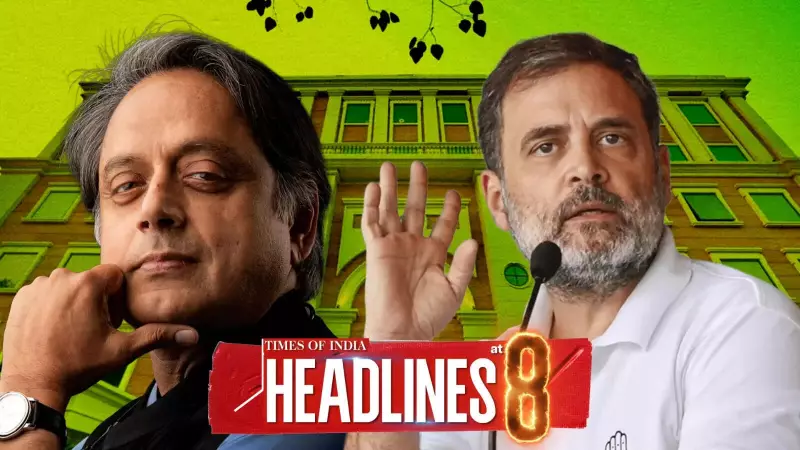
Fresh political fault lines have opened up across India and beyond, signaling potential shifts in both domestic and international landscapes. In Kerala, the Congress party is staring at significant internal churn as senior leader Shashi Tharoor skipped a crucial high-command meeting, raising serious questions about unity ahead of upcoming crucial polls.
Congress Faces Internal Discord in Kerala
Tharoor's absence from the key meeting came after what many perceived as a snub at a recent Rahul Gandhi event, where his role and visibility were reportedly diminished. This development has sparked intense speculation within political circles about growing fissures within the party's Kerala unit. With important elections on the horizon, the timing of this apparent discord could not be more critical for the Congress's electoral prospects in the southern state.
Political analysts suggest that Tharoor's decision to skip the meeting might reflect deeper discontent within certain factions of the party, potentially complicating the Congress's strategy for maintaining its influence in Kerala politics. The situation highlights the ongoing challenges political parties face in balancing internal dynamics while preparing for competitive electoral battles.

Tamil Nadu Escalates Battle with Central Government
Meanwhile, in neighboring Tamil Nadu, Chief Minister MK Stalin has sharpened his state's battle with the Centre by formally rejecting the G-RAM-G scheme. The Tamil Nadu government has instead demanded the return of the Mahatma Gandhi National Rural Employment Guarantee Act (MNREGA), framing the issue as a matter of welfare and state autonomy.
This rejection was timed just hours before Prime Minister Narendra Modi's scheduled visit to the state, effectively turning what could have been a routine welfare discussion into a full-blown political showdown. The move demonstrates how regional parties are increasingly using policy disagreements to assert their political positions against the central government, particularly in matters concerning social welfare and economic development.
Zelensky Announces Historic Diplomatic Initiative
On the global stage, diplomacy meets warning signs as Ukrainian President Volodymyr Zelensky announced the first-ever Ukraine-US-Russia talks to be held in the United Arab Emirates. This groundbreaking diplomatic initiative represents a potential breakthrough in the ongoing conflict, though Zelensky simultaneously cautioned European nations against becoming overdependent on Washington for security matters.
The announcement of these trilateral talks marks a significant development in international efforts to address the Ukraine crisis through dialogue. By choosing the UAE as the venue, the parties involved are signaling a preference for neutral ground that might facilitate more productive discussions. However, Zelensky's accompanying warning to Europe suggests complex geopolitical calculations are at play, with concerns about long-term strategic autonomy influencing diplomatic maneuvers.
These parallel developments in Indian politics and global diplomacy underscore how political dynamics continue to evolve rapidly, with domestic party politics intersecting with international relations in ways that could shape both regional stability and global power balances in the coming months.