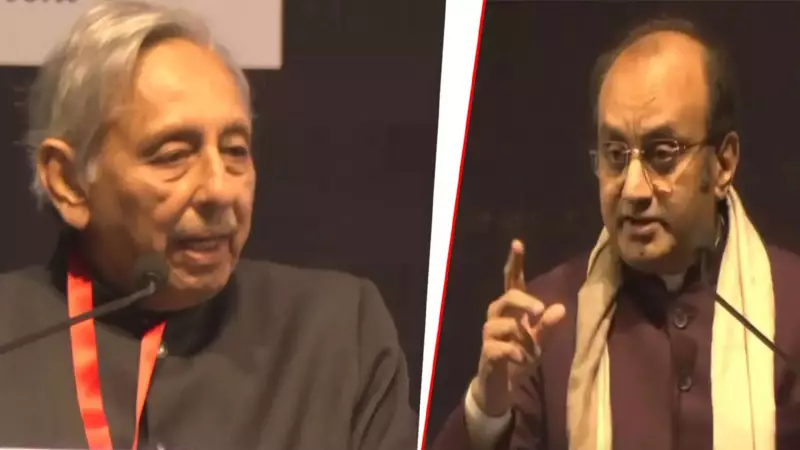
A high-profile debate in Kolkata has ignited a fresh political and ideological firestorm over the interpretation of Hinduism and its relationship with Hindutva. The event, organized by The Calcutta Debating Circle and titled 'Hinduism Needs Protection From Hindutva', featured a sharp exchange between senior political figures on January 12, 2026.
Clash of Ideologies: 'Perversion' vs 'Essential Spirit'
The debate saw Congress leader Mani Shankar Aiyar launch a strong critique, labelling Hindutva as 'the perverter of Hinduism'. He argued that while Hinduism is founded on pluralistic and inclusive values, the political ideology of Hindutva promotes fear, intolerance, and attacks on minority communities and their practices.
In a robust defence, BJP MP and spokesperson Sudhanshu Trivedi countered that Hindutva is, in fact, the 'Hindu tattva' – the essential, core spirit of Hinduism itself. He emphasized the unique character of the Hindu faith, which he said allows for questioning and debate even within its sacred texts, a feature not commonly found in other religions.

Trivedi's Central Arguments and a Question of Terminology
Trivedi further delved into the semantics often used to describe Indian faiths. He questioned why religions originating in India are frequently suffixed with '-ism' (like Hinduism), a Western construct, while their intrinsic nature is more about philosophy and way of life (tattva).
The BJP leader also addressed a common political charge, stating that an expression of pride and love for Hinduism is often deliberately and wrongly conflated with support for the political concept of Hindutva. This, he implied, creates a false binary where cultural reverence is misinterpreted as majoritarian politics.
A Microcosm of India's Broader Discourse
The fiery session, which also included perspectives from TMC's Mahua Moitra and lawyer J. Sai Deepak, became a microcosm of the larger, ongoing national conversation. The debate highlighted the stark and seemingly irreconcilable differences in how India's dominant religion, its cultural identity, and modern politics intersect.
The arguments presented at The Debate 2026 underscore the deep ideological divide that continues to shape public and political discourse in the country. The event reaffirmed that the interpretation of Hinduism, Hindutva, and Indian secularism remains one of the most potent and polarizing themes in contemporary India.