

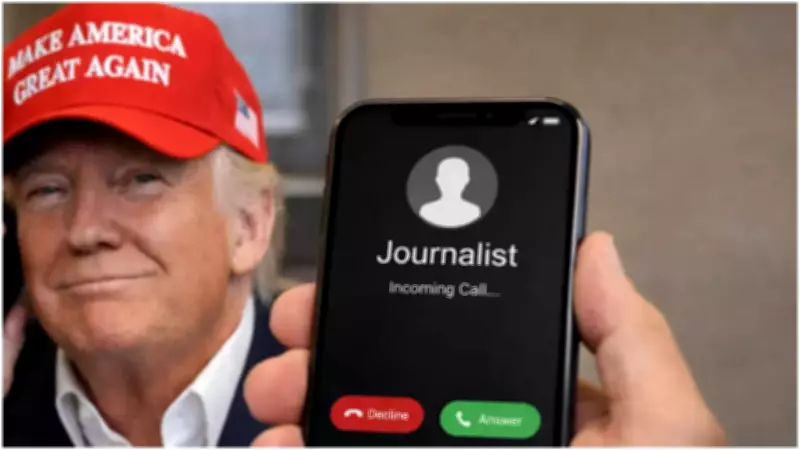
Trump's Personal Cellphone Becomes Direct Hotline for Journalists
In the carefully controlled world of Washington politics, where access to power typically requires formal press briefings and official interview requests, a surprising new pathway has emerged with former President Donald Trump. According to multiple reports, Trump's personal cellphone number has become one of the worst-kept secrets in political journalism, creating an unprecedented direct line between the former president and reporters.
The Unusual Media Ritual
Trump has reportedly fielded dozens of impromptu calls from journalists in recent weeks, often answering without screening the caller and launching into brief, off-the-cuff conversations. These spontaneous exchanges cover everything from domestic politics to international conflicts like the ongoing tensions between Israel and Iran. The result is what Semafor describes as "a strange new media ritual" where reporters dial the president directly in hopes he'll pick up.
The calls come at all hours — late at night when Trump can't sleep, after a round of golf when he's in a good mood, or while he's watching television in the evening. Some journalists even time their calls for moments immediately after Trump posts on his social media platform Truth Social, believing he's then most eager to share his thoughts.

Dozens of Direct Interviews
Trump has conducted more than 30 cellphone interviews with reporters from outlets ranging from The New York Times to Washington Reporter. Earlier this month, ABC News journalists Jonathan Karl and Rachel Scott each conducted separate interviews with him on the same day, during which Trump discussed the Iranian situation with both reporters.
"The calls came at varied times, including late at night when the President could not sleep, in the evenings while he watched TV, after a game of golf when he was in a good mood, and early in the morning," according to sources familiar with the pattern. Some reporters noted he could be "a little snappy" during early morning calls.
White House Perspective on the Practice
A White House official, speaking on condition of anonymity, suggested Trump doesn't take these calls seriously and sometimes uses them for amusement. "When the President picked up, he is often preoccupied, puts them on speaker in front of a large group of people, and he is loosely chatting and has fun messing with them," the official said.
The official added a critical perspective: "Reporters who think they are being serious journalists by calling him are frankly doing themselves a disservice."
Limited Impact and Journalistic Dilemma
The Atlantic recently noted that few of these interviews have led to a lasting impact on the nation's understanding of major issues like international conflicts. Despite this, the temptation persists among journalists.
One Washington journalist who has spoken with Trump over the years described the experience: "I feel like Frodo with the ring. I know it's dangerous, but it keeps beckoning me."
According to reports, Trump's personal cellphone usage increased between his two terms, as he swapped Manhattan area code numbers for a Florida number that began circulating more widely. He reportedly started texting more regularly with friends, businesspeople, and influential Republicans during this period.
The Quest for Access
The Atlantic reported that after reading what felt like "the 50th exclusive phone interview with Trump," one journalist set out to obtain the president's number and call him directly. This was done to test whether possessing the number truly represented the "holy grail" of access journalism. There have even been suggestions that Trump's number might be available to the highest bidder, though this remains unconfirmed.
This unusual access pattern represents a significant departure from traditional White House media relations, creating both opportunities and ethical questions for journalists covering the former president and current political landscape.






