

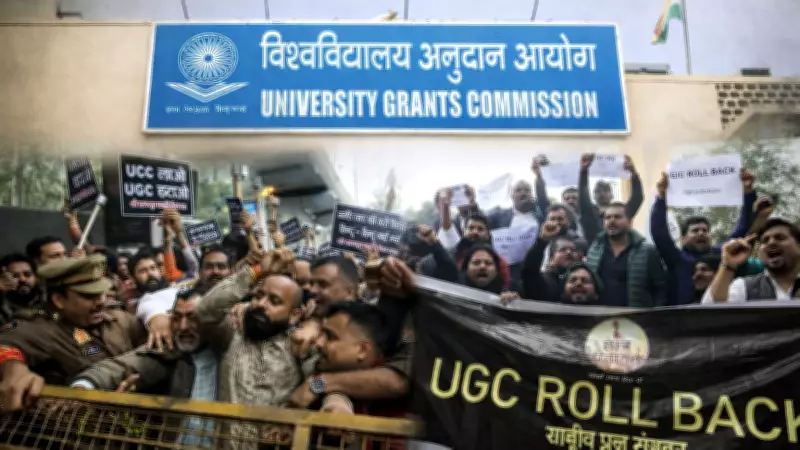
UGC Equity Regulations Spark Political Storm as OBC Issues Take Center Stage
The University Grants Commission's equity regulations have created a significant political challenge for the ruling BJP government, with the Supreme Court's intervention and state-level countermeasures highlighting growing concerns about caste-based discrimination in higher education institutions across India.
Supreme Court Intervention Halts UGC Regulations
The Supreme Court has stayed the University Grants Commission (Promotion of Equity in Higher Education Institutions) Regulations, 2026, citing "vague" language and concerns that the rules could potentially "divide" society. This judicial intervention has effectively stalled the Centre's initiative to include Other Backward Classes among vulnerable groups facing caste-based discrimination in educational institutions.
The regulations, notified on January 13, had already triggered widespread student protests before reaching the Supreme Court. The court's decision has created a complex situation for the BJP-led government, which now faces criticism from multiple directions regarding its approach to addressing caste discrimination in higher education.

Karnataka's Countermeasure: The Rohith Vemula Bill
While the Centre's UGC regulations remain suspended, the Congress-led Karnataka government has drafted the Rohith Vemula Bill to specifically address discrimination against Scheduled Castes, Scheduled Tribes, OBCs, and minority students in higher education institutions.
Named after Rohith Vemula, the University of Hyderabad research scholar who died by suicide in 2016 following alleged caste-based discrimination, the bill represents a state-level response to what many see as a national crisis in educational equity.
Congress leader and Raichur MP G Kumar Naik explained the rationale behind the bill: "The Rohith Vemula Bill has been planned because we noticed that SC, ST, OBC and minority students are now taking to higher education in large numbers. Many with rural backgrounds are first-generation learners, and there have been instances of discrimination. So the Karnataka government decided to step in."
BJP's Political Dilemma Deepens
The UGC regulation controversy has created what political observers describe as a "double bind" for the BJP. Party insiders acknowledge growing unease within the organization as it navigates competing demands from different caste groups.
A senior OBC leader from the BJP, speaking on condition of anonymity, admitted that the party is "seized of the issue" regarding discrimination complaints from OBC communities but emphasized that the Supreme Court must make the final determination on the UGC regulations.
The political calculations are particularly delicate. As one senior All India Congress Committee leader from the OBC community noted: "We knew it was a win-win for us and a catch-22 situation for the BJP. If they withdrew the regulations, they would antagonise the SC, ST and OBC communities, and if they did not, they would anger upper-caste voters who are their base."
Understanding the Caste Categories: SC, ST, and OBC
The current controversy highlights fundamental differences in how India's various caste categories have been historically defined and legally recognized:
- Scheduled Castes: This category originated from communities historically subjected to untouchability. The Constitution abolished untouchability and provided reservations for SCs and STs.
- Other Backward Classes: Unlike SCs and STs, OBCs were defined based on social and educational backwardness rather than historical oppression. The Mandal Commission established criteria for identifying OBC communities in 1979.
- Legal Protections: While specific laws protect SCs and STs from discrimination (including the SC/ST Prevention of Atrocities Act), OBCs have historically had fewer legal safeguards against discrimination.
Institutional Mechanisms for Addressing Discrimination
The debate over UGC regulations has brought renewed attention to existing institutional frameworks for addressing caste discrimination:

- The National Commission for Scheduled Castes has provisions to address discrimination against OBCs under specific constitutional interpretations.
- The National Commission for Backward Classes, which became a constitutional body in 2018, now possesses civil court powers to address OBC grievances.
- Former NCBC chairperson Hansraj Ahir noted that the commission actively addresses OBC concerns regarding admissions and employment opportunities.
The Demographic Context and Political Implications
OBCs constitute approximately half of India's population, though precise numbers await the 2027 Census, which will enumerate castes for the first time since Independence. This demographic reality makes OBC issues particularly significant in political calculations.
The current controversy reflects broader tensions between different approaches to addressing caste discrimination: whether to focus on historical oppression (as with SCs) or contemporary social and educational backwardness (as with OBCs).
As the Supreme Court deliberates on the UGC regulations and Karnataka moves forward with its Rohith Vemula Bill, the political landscape continues to evolve. The BJP finds itself navigating between competing caste interests while opposition parties position themselves to capitalize on the government's challenges.
The ultimate resolution of this controversy will likely have significant implications for educational policy, caste politics, and India's ongoing efforts to address historical inequities in higher education access and experience.





