

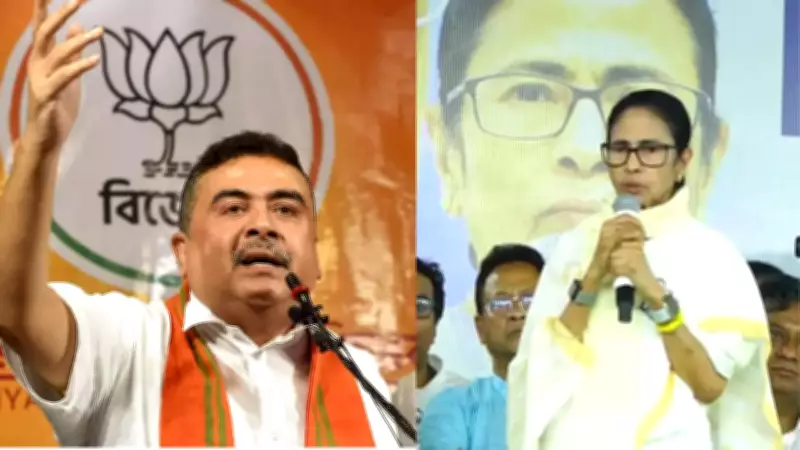
West Bengal is witnessing the decisive second phase of its 2026 assembly elections, with polling underway across 142 constituencies. This phase is crucial in determining the state's political future, as over 3.22 crore voters are eligible to cast their ballots among more than 1,400 candidates. The focus is particularly on south Bengal and the Kolkata region, traditionally strongholds of the ruling Trinamool Congress (TMC).
High-Stakes Contests and Key Candidates
Chief Minister Mamata Banerjee faces a stiff challenge from the Bharatiya Janata Party (BJP), which has fielded Suvendu Adhikari in the high-profile Bhabanipur constituency. The election has been shaped by a record 93.2 per cent turnout in phase 1, indicating strong voter mobilisation. The Special Intensive Revision (SIR) of electoral rolls has emerged as a key issue, with large-scale deletions influencing voter behaviour and campaign narratives.
Matua Vote and Electoral Roll Controversy
The Matua Namasudra community, particularly influential in North 24 Parganas and Nadia, faces uncertainty due to large-scale deletions under the SIR. Lakhs of names have been struck off or marked under adjudication, raising concerns about voter eligibility. In North 24 Parganas alone, around 3.25 lakh deletions have been recorded. This issue overlaps with pending citizenship applications under the Citizenship Amendment Act (CAA), adding complexity to the electoral dynamics.

Security and Pre-Poll Crackdown
Authorities have apprehended 2,473 people across West Bengal in a major pre-poll crackdown to ensure peaceful voting. The highest number of detentions occurred in Purba Bardhaman (479), followed by North 24 Parganas (319) and South 24 Parganas (246). The Election Commission has deployed extensive central forces and observers in sensitive constituencies.
Since mid-March, authorities have seized 390 arms, 598 rounds of ammunition, over 1,300 crude bombs, and more than 222 kg of explosives. Additionally, 41,706 licensed weapons have been deposited out of 52,869. Enforcement agencies have also seized inducements worth Rs 532.88 crore, including cash, liquor, drugs, and freebies.
Voter Guidelines and Exit Polls
Election authorities have issued guidelines for voters, requiring valid photo identification such as EPIC, Aadhaar card, or passport. Mobile phones are not permitted inside polling stations, and voters are advised not to display any political symbols. Officials urge voters to verify their vote through the VVPAT system after casting it on the EVM.
Exit poll projections will be released after 6:30 pm on April 29, following the conclusion of voting. As per Election Commission guidelines, no exit poll data can be published before polling ends. With this being the final phase, projections are expected to offer an early indication of the likely outcome ahead of the official results on May 4.
Political Dynamics and Campaigning
Chief Minister Mamata Banerjee's 'Brand Didi' image is under pressure after 15 years in power, facing anti-incumbency, corruption allegations, and an aggressive push by the BJP. While schemes such as Lakshmir Bhandar and Khadya Sathi continue to anchor her support base, recent controversies and the SIR of electoral rolls have added new layers to the contest. The BJP has framed the election around governance and change, while the TMC positions it as a fight to protect Bengal's identity.
Campaigning saw sharp political exchanges, symbolic outreach, and security concerns. Prime Minister Narendra Modi's outreach and Mamata Banerjee's grassroots push were key features, alongside aggressive positioning by Amit Shah and criticism from opposition leaders.
The results on May 4 will determine whether the TMC retains power or the BJP makes a decisive breakthrough. With high turnout already recorded and a crucial second phase underway, the election is increasingly seen as a referendum on Mamata Banerjee's leadership and the future of West Bengal's politics.






