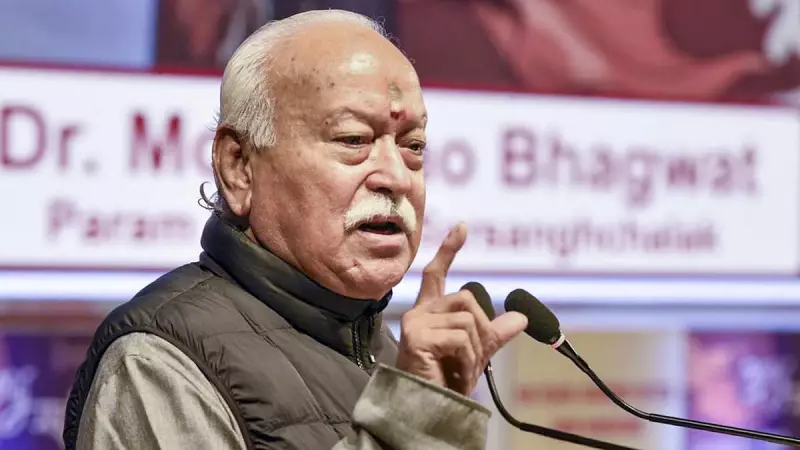
In a significant address, Rashtriya Swayamsevak Sangh (RSS) chief Mohan Bhagwat has firmly stated that the organisation is not a paramilitary force and its work and character cannot be understood merely by observing the actions of the Bharatiya Janata Party (BJP). The remarks were made during a lecture series in Nagpur, Maharashtra.
Clarifying the Sangh's Identity and Work
Mohan Bhagwat, the Sarsanghchalak of the RSS, delivered the third lecture in the 'Rashtra Devo Bhav' series at the Reshimbagh ground. He emphasized the distinct nature of the Sangh's work, which is rooted in societal organization and character-building. Bhagwat categorically stated, "RSS is not a paramilitary organisation." He elaborated that the Sangh's methodology involves daily gatherings (shakhas) where volunteers engage in physical exercise, ideological discussions, and patriotic songs, all aimed at fostering discipline and national spirit.
He addressed a common perception, urging people not to view the RSS through the narrow lens of political developments. "The Sangh's work cannot be understood by looking at the BJP," Bhagwat asserted, drawing a clear line between the cultural and social work of the RSS and the political activities of the BJP, which is its ideological affiliate.

Context and Broader Message
The lecture series, which began on March 19, is part of the RSS's ongoing outreach to explain its vision and dispel misconceptions. Bhagwat's comments come at a time when the opposition often labels the RSS as a militant or extremist group. By rejecting the 'paramilitary' tag, the RSS chief aimed to reframe the narrative around the world's largest voluntary organization.
Bhagwat spent a considerable portion of his speech explaining the core philosophy of the Sangh. He described it as an organization dedicated to uniting society and instilling a sense of selfless service (seva) and national devotion. The ultimate goal, as per his address, is to contribute to the creation of a harmonious and prosperous India that is confident in its civilizational values.
Distinction from Political Machinery
A key takeaway from the address was the reiterated separation between the RSS's societal role and the political sphere. While the BJP draws its ideological inspiration from the RSS, Bhagwat's statement underscores that the two entities operate in different domains with separate operational frameworks. The Sangh, he implied, is a broader movement focused on long-term societal transformation, which should not be conflated with the day-to-day governance and political strategies of the ruling party.
This clarification is seen as an effort to maintain the RSS's unique identity and protect its core work from being solely defined by the electoral fortunes or policies of the BJP. It reinforces the Sangh's position as the ideological fountainhead rather than a direct political or paramilitary actor.
In conclusion, Mohan Bhagwat's Nagpur lecture served as a definitive articulation of the RSS's self-image. By denying the paramilitary characterization and decoupling the Sangh's perception from the BJP's actions, the RSS chief has made a clear bid to define the organization on its own terms, focusing on its foundational mission of societal unity and character building.