

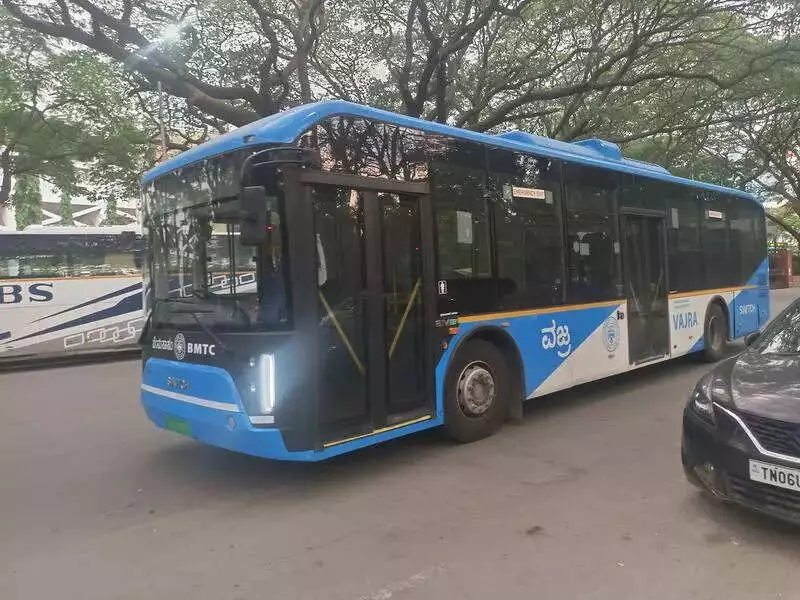
The ambitious plan of the Bangalore Metropolitan Transport Corporation (BMTC) to significantly expand its popular and affordable Vayu Vajra airport bus service has hit a major roadblock. The decision by the Bangalore International Airport Ltd (BIAL) to drastically reduce the number of bus bays at Terminal 1 (T1) of Kempegowda International Airport (KIA) has forced the public transporter to reconsider its expansion, dealing a blow to affordable airport connectivity for Bengaluru's residents.
Space Crunch Forces Plan on Hold
BMTC had proposed adding 50 new buses to launch services on additional routes connecting the airport to more parts of the city. However, officials now state this plan is likely to be put on hold indefinitely due to acute space constraints at Terminal 1. A BMTC official posed a critical question, highlighting the operational deadlock: "When there is no space to operate, what is the point of adding new buses?" The official warned that this infrastructure squeeze would inevitably push air passengers towards more expensive taxi services.
Halved Capacity and Mounting Losses
The core of the issue lies in the reduction of operational space. The number of dedicated bus bays at T1 was slashed from 14 down to just seven after an entire row was removed and allotted to a private taxi operator. This has created severe operational challenges for BMTC, which currently runs 156 Vayu Vajra buses across 22 routes, including to distant suburbs like Attibele and Jigani, located over 65 km away.

Officials revealed that nearly 80% of airport bus passengers board at T1, which also generates the bulk of BMTC's airport-related revenue. The impact has been immediate and negative. Since the reduction in bays, daily ridership has dropped by over 1,000 passengers, translating to a staggering daily revenue loss of Rs 3-4 lakh for the corporation.
Congestion, Missed Buses, and Passenger Inconvenience
The operational reality on the ground has deteriorated sharply. A senior BMTC official explained that the earlier two-row, 14-bay layout allowed for smooth parking and operations. "Now everything has been squeezed into a single row," the official said. "Earlier, we handled 532 departures using two rows. With only one row now, congestion builds up very quickly."
This congestion forces a drastic change in scheduling. Buses are now compelled to depart within minutes of arriving at the terminal to avoid pile-ups, unlike before when they could wait longer to accommodate passengers. This rushed turnaround has led to passengers frequently missing their preferred bus and opting for taxis out of frustration. "We are now being forced to compete with taxi operators, who have reached an agreement with BIAL," lamented the BMTC official.
The corporation expressed its readiness to extend affordable airport services from many more locations but emphasized that without adequate terminal parking space, expansion is simply not feasible. While BIAL has not issued an official statement on the controversy, the move has drawn sharp criticism online from urban mobility observers. Commentator S Shekar called it a "retrograde step," urging a focus on increasing public transport infrastructure around KIA instead of a "cars-only" approach that worsens congestion in Namma Bengaluru.
The situation presents a clear conflict between infrastructure management and public transport goals, with the city's commuters, who rely on the cost-effective Vayu Vajra service—where fares max out at Rs 430 even for the longest routes—bearing the brunt of the consequences.






