

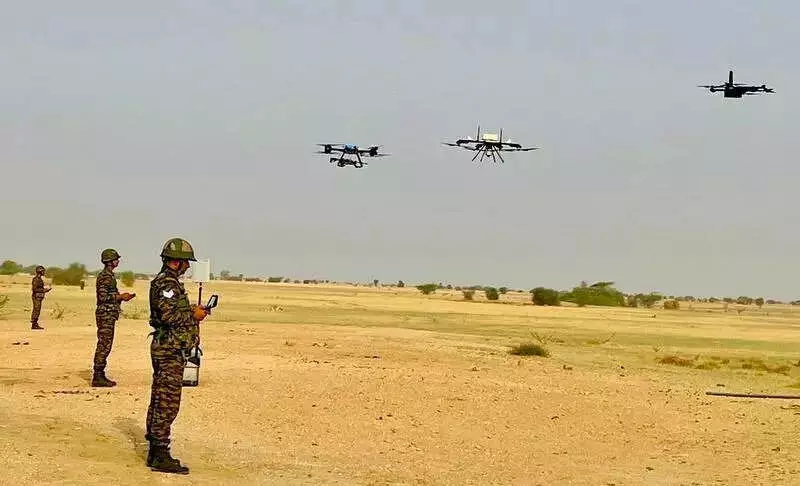
In a major push for self-reliance in defence, the Indian Army has placed a substantial Rs 500 crore contract with Pune-based defence public sector undertaking, Munitions India Limited (MIL), for the manufacturing and supply of advanced drones. This landmark order, secured under the Army's emergency procurement powers, is set to significantly enhance the nation's indigenous defence manufacturing capabilities and battlefield preparedness.
Boosting Indigenous Defence Ecosystem
The contract specifically pertains to the supply of loitering munitions, often referred to as kamikaze drones. A senior MIL official stated that this move by the Indian Army aims to boost indigenous systems and will serve as a crucial incentive. "It is expected to change the private defence ecosystem in Pune and other cities," the official told TOI, confirming that MIL is prepared to meet the force's operational requirements and deliver within the stipulated deadline.
This order marks a significant milestone as it is the first time a public sector undertaking has received such a large-scale drone order from the Indian Army, underscoring MIL's growing technological prowess in the unmanned systems domain. Munitions India Limited, which falls under the Ministry of Defence, operates seven ordnance factories across the country.

Collaboration and Strategic Impact
In an anonymous briefing, another official revealed that MIL will work in tandem with private players who have been aggressively involved in drone manufacturing over the last few years. "It will be a joint effort in some projects. MIL will take care of the payload (ammunition) in these drones since it has expertise in ammunition and weapon systems," the official added. Systems from some of these private companies have already been inducted into the Army.
The procurement, initiated following Operation Sindoor, is designed to rapidly enhance the Army's operational readiness by inducting cutting-edge unmanned combat systems. A senior defence official explained that loitering munitions are designed to hover over target areas and strike with high precision, dramatically improving surveillance, targeting, and overall battlefield effectiveness. "Such systems are becoming increasingly important in modern warfare, particularly in high-intensity and asymmetric conflict scenarios," the official noted.
Restructuring for Modern Warfare
This acquisition aligns with the Army's broader restructuring of its infantry battalions. The force is in the process of revamping the role of all its 382 infantry battalions, each comprising about 800 soldiers. As part of the 'eagle on the arm' concept, the Army is raising first-person-view (FPV) 'Ashni' drone platoons.
A senior infantry officer detailed that "these platoons consist of 20 to 25 tech-savvy soldiers, who will be equipped with short and medium-range loitering munitions for various operational requirements." This integration of advanced drone technology is set to transform traditional infantry tactics.
In a related development, a few private companies demonstrated their drone systems to a Nigerian delegation at the Ammunition Factory Khadki ground in Pune on Wednesday. Sources indicated that the delegation was also briefed on other advanced systems being developed at the factory and by private firms, highlighting the growing international interest in India's defence manufacturing sector.






