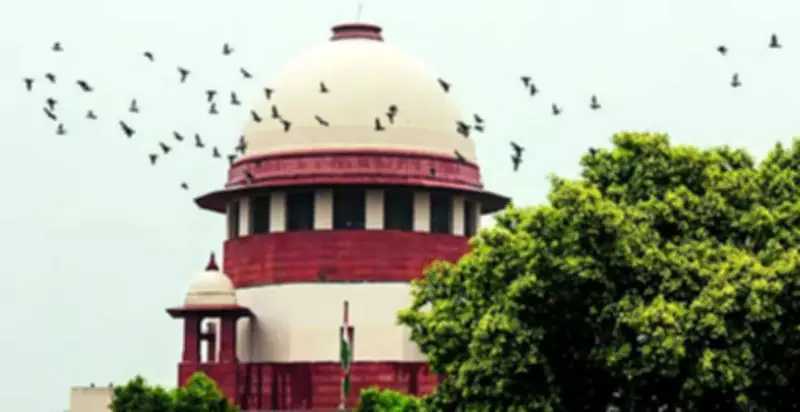
The Centre on Friday posed a pointed question to the Supreme Court amid an escalating conflict between two benches over whether delay in trial entitles those facing grave charges under the Unlawful Activities (Prevention) Act (UAPA) to bail. It asked whether dreaded terrorists like Ajmal Kasab and Hafiz Saeed should be granted bail merely because of a delay in the trial.
Centre's Argument Against Generalisation
Additional Solicitor General S V Raju and advocate Rajat Nair, appearing for the Centre, questioned the court's verdict that delay in trial and long incarceration could be grounds for bail under special laws like the Prevention of Money Laundering Act (PMLA) and UAPA. They argued that there cannot be a grand generalisation to grant bail on grounds of delay. Instead, the nature of the offence and the individual's role in it must be examined, as done by the court while granting bail to five accused in the 2020 Delhi riots case but denying relief to Umar Khalid and Sharjeel Imam.
Examples of Kasab and Saeed
ASG Raju contended before a bench of Justices Aravind Kumar and P B Varale that in the Ajmal Kasab case, there was a delay due to a large number of witnesses. He asked, "Will you grant him bail on the ground of delay? If Hafiz Saeed is brought from Pakistan, will you grant him bail on the ground of delay?" The bench had earlier denied bail to Delhi riots accused Umar Khalid and Sharjeel Imam but granted relief to five others in the same case.

Severity of Offence and Delay Responsibility
ASG Raju's contention aligned with the reasoning of Justices Kumar and Varale that prolonged incarceration cannot be mathematically used as a ground for releasing UAPA accused. Factors such as the severity of the offence and who was responsible for the delayed trial must be taken into account.
Stringent Bail Conditions Under TADA
Referring to the Supreme Court's earlier order upholding stringent bail conditions under the Terrorist and Disruptive Activities (Prevention) Act (TADA), Raju said that provisions have been prescribed under the law for the grant of bail. He noted that the legislature consciously decided to sacrifice to some extent the personal liberties of undertrial accused for the sake of protecting the community and nation against terrorist and disruptive activities or other activities harmful to society.
"The proper course is to identify from the nature of the role played by each accused person the real hardcore terrorists or criminals from others who do not belong to that category and apply the bail provisions strictly in so far as the former class is conceived and liberally in respect of the latter class," he said. He added that bail cannot be mechanically granted on the ground of delay.