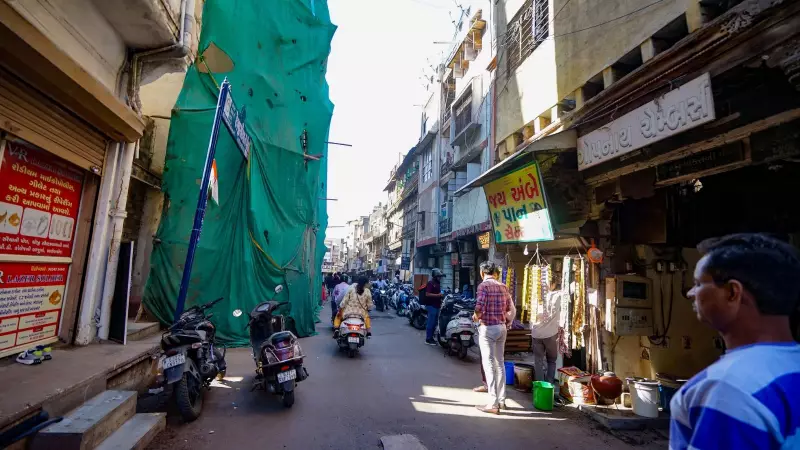
In the heart of Ahmedabad's historic walled city, a narrow 300-metre lane named Sankdi Sheri has become the focus of an ambitious pilot project. The initiative, led by a team from CEPT University, aims to craft a blueprint that marries heritage conservation with modern urban mobility solutions. This Local Area Plan (LAP) seeks to address chronic issues like traffic congestion while enhancing pedestrian spaces and reclaiming the public realm, all within the area's rich cultural context.
A Blueprint for the Walled City
The project holds significance beyond this single street. If approved by the Ahmedabad Municipal Corporation (AMC), the model developed for Sankdi Sheri could be replicated for the development of other precincts within the UNESCO World Heritage-listed walled city. Sankdi Sheri itself is one of the 57 precincts included in Ahmedabad's UNESCO dossier, noted for its unique pol network that fosters community interaction.
The street, once a thriving jewellers' market, is lined with heritage structures ranging from grand havelis with Gothic windows and carved wooden cornices to more modest buildings. The area contains 3 Grade IIA heritage structures, 7 Grade IIB, and 11 Grade III structures, as per the conservation grading system outlined in the Gujarat Gazette. This grading is a policy tool designed to protect heritage systematically while guiding urban development.

Incentives and Regulations for Preservation
The CEPT team's comprehensive plan proposes a mix of regulatory measures and financial incentives to encourage preservation. Key suggestions include stringent facade design regulations to maintain the street's historic character. For instance, all street-facing facades must align with the original building line, and architectural replication must use authentic traditional materials, prohibiting artificial substitutes.
To make conservation economically viable for owners, the plan recommends significantly boosting Transferable Development Rights (TDR). The proposal suggests increasing TDR from the existing 50% of utilised Floor Space Index (FSI) to 150-200% for the highest-graded heritage structures. This creates a Heritage TDR (HTDR) that owners can sell for profit. Additional concepts like 'Conservation Credits'—where developers fund restoration in exchange for subsidised FSI—and regular maintenance incentives every five years are also on the table.
Addressing Ground Realities and Future Vision
A site survey revealed pressing challenges: neglected graded structures, a tangle of overhead wires, dilapidated buildings, and excessive signage. To solve traffic and pedestrian issues, the plan proposes creating short loop circuits on minor roads and reconfiguring traffic along nearby Manek Chowk and Gandhi Roads.
Ahmedabad Municipal Commissioner Banchhanidhi Pani confirmed the AMC's interest, stating the site has been studied as a potential pilot LAP for heritage revitalisation. However, local stakeholders like developer Rajeev Patel, who restored Deewanji ni Haveli in the street, express concern over the pace of action post the 2017 UNESCO tag, urging faster, large-scale restoration.
Professor Jignesh Mehta of CEPT explained Sankdi Sheri was chosen for its feasibility and visibility as a starting point. The team, drawing inspiration from global examples like Kyoto, Japan, envisions this LAP as a template, to be prepared precinct by precinct, ensuring Ahmedabad's historic core thrives without losing its soul to unchecked development.