

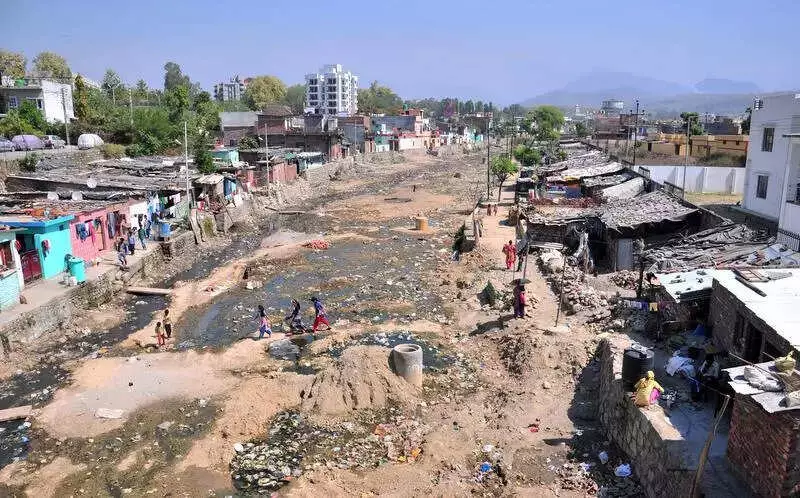
A significant citizen movement is gaining momentum in Uttarakhand's capital, with residents of Dehradun and Mussoorie formally urging Union Minister Nitin Gadkari to immediately stop the proposed Rispana-Bindal elevated road project. The collective, comprising around 150 signatories, has outlined a comprehensive list of 21 major objections centered on public safety, environmental degradation, and flawed urban planning.
Citizen Coalition Flags Critical Risks
The signatories, associated with the Dehradun Citizens Forum and other local groups, represent a wide cross-section of society. The list includes social activist Anoop Nautiyal, architect Bharti Jain, historian Ganesh Saili, and Congress leader Abhinav Thapar, alongside numerous professionals, retired officials, academicians, and traders. Their unified letter highlights that the 26-km elevated road, announced earlier in 2024, would exacerbate the city's existing struggles with unplanned growth, severe traffic congestion, and ecological stress.
Foremost among their concerns is the region's extreme seismic vulnerability. The letter points out that Dehradun lies between the Main Boundary Thrust and the Himalayan Frontal Thrust, placing it in the highest seismic risk category on recent Bureau of Indian Standards (BIS) maps. It further warns that the riverbeds of Rispana and Bindal, composed of loose sand, gravel, and silt, are prone to liquefaction during even moderate earthquakes. This poses a grave threat to the stability of the elevated pillars and the safety of nearby residential areas.

Environmental and Social Fallout
Drawing a direct link to the catastrophic flash floods of September 15-16, 2024, which claimed 30 lives in Dehradun, citizens argue that constructing over riverbeds will obstruct natural water flow. This, they contend, will significantly increase flood risks in low-lying zones such as IT Park, Dalanwala, Race Course, and Inder Road. The project is also expected to cause irreversible damage to river ecosystems, accelerate the loss of groundwater recharge, and worsen urban heat island effects—a concern underscored by the city recording temperatures as high as 43°C during the extreme summer of 2024.
On the social front, activists highlight that nearly 3,000 families living along the riverbanks for decades face displacement without a clear and transparent rehabilitation plan. The livelihoods of countless small shopkeepers and informal workers dependent on the riverine economy are also at stake. The letter alleges a severe lack of transparency, noting that no detailed project report (DPR), environmental impact assessment (EIA), project maps, or clear displacement data have been made public. It also claims that mandatory public hearings were not properly documented and that citizens raising questions faced intimidation.
Financial and Traffic Viability Questioned
The financial rationale of the project has also come under sharp scrutiny. Residents point out that the estimated cost has already ballooned from Rs 4,500 crore to Rs 6,200 crore even before the start of construction, with fears of further escalation. From a traffic management perspective, they argue the elevated road will fail to solve local congestion. Instead, it could create new bottlenecks at Mussoorie diversion points and offer minimal relief at key city intersections like Saharanpur Chowk, Balliwala, Ballupur, Survey Chowk, and Araghar.
As an alternative, the citizens' forum has urged the government to abandon concrete-heavy projects and focus on sustainable, holistic solutions. Their recommendations include river restoration, creating blue-green corridors, enhancing public transport systems, building public parking facilities, and developing pedestrian and cycling infrastructure protected by tree buffers. This appeal presents a critical juncture for Dehradun's future, pitting large-scale infrastructure development against community-driven, environmentally conscious urban planning.






