

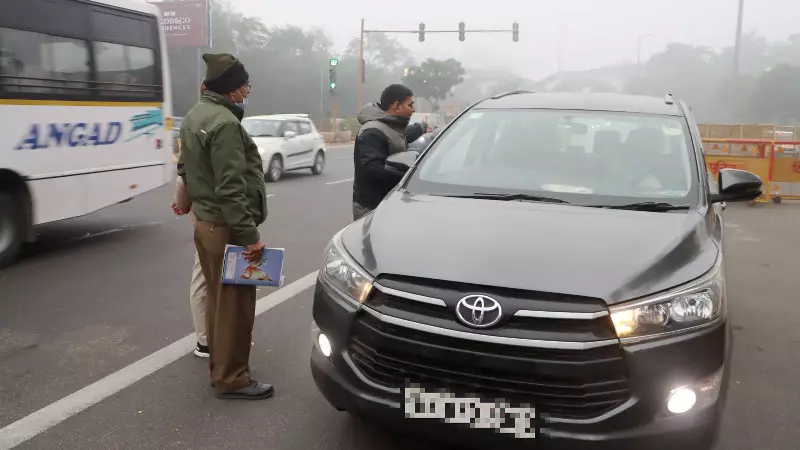
Delhi's crackdown on vehicles violating BS-VI emission norms entered its second day on Friday, with authorities intensifying checks at the city's borders. The drive, aimed at curbing severe air pollution, resulted in hundreds of vehicles being denied entry and penalised.
Strict Enforcement at Borders
According to data released by the Delhi Traffic Police, a total of 5,037 private vehicles were inspected at various border points on Friday. Out of these, 419 cars were ordered to return for failing to comply with the BS-VI standards. Additionally, 374 vehicles were issued challans (fines) for flouting the norms.
This marks an increase from the first day of the campaign on Thursday, when 2,768 vehicles were checked, 460 were turned back, and 289 challans were issued specifically for BS-VI violations.

Widespread Penalties for Pollution Certificates
The enforcement action was not limited to border checks. Across the national capital, a significant number of penalties were levied for not carrying valid Pollution Under Control Certificates (PUCC). On Thursday alone, 2,986 challans were issued for invalid PUCCs. Data indicates that the Western range of Delhi recorded the highest number of such fines (881), while the New Delhi district saw the lowest (357).
Cumulatively, the traffic police have issued 13,434 PUCC challans inside Delhi for violations under the stringent Graded Response Action Plan (GRAP) Stage IV. Delhi's Environment Minister, Manjinder Singh Sirsa, stated that enforcement teams issued a total of 11,776 challans against polluting and non-compliant BS-VI vehicles over a 24-hour period starting Thursday evening.
Traffic Managed Amid Intensive Checks
Senior police officers expressed relief that the large-scale checking operations did not lead to major gridlock in the city. They credited meticulous planning and deployment for the relatively smooth traffic flow.
Additional Commissioner of Police (Traffic), Satyavir Katara, remarked that it was "nothing short of a miracle" that Delhi avoided severe jams, unlike cities such as Mumbai or Bengaluru. He acknowledged delays of 30-40 minutes but emphasized that personnel were strategically deployed to manage traffic and prevent long, static queues.
Out of a total strength of 5,200 personnel, 4,000 Delhi Traffic Police officials have been deployed for this task, assisted by forces from Haryana, Uttar Pradesh, and the Transport Department. Katara explained the strategy: "If three to five men are stationed in one place, all five will not be checking documents. Some will be responsible for ensuring there is no traffic jam."
Another senior officer, Additional Commissioner of Police (Traffic) Dinesh Gupta, denied any manpower shortage but raised concerns about the health of personnel conducting 12-hour shifts during peak pollution periods. He confirmed that masks are provided and their use is advised constantly.
The campaign reflects the Delhi government's heightened efforts to tackle the annual air quality crisis, focusing on one of the major contributors to pollution—vehicular emissions.






