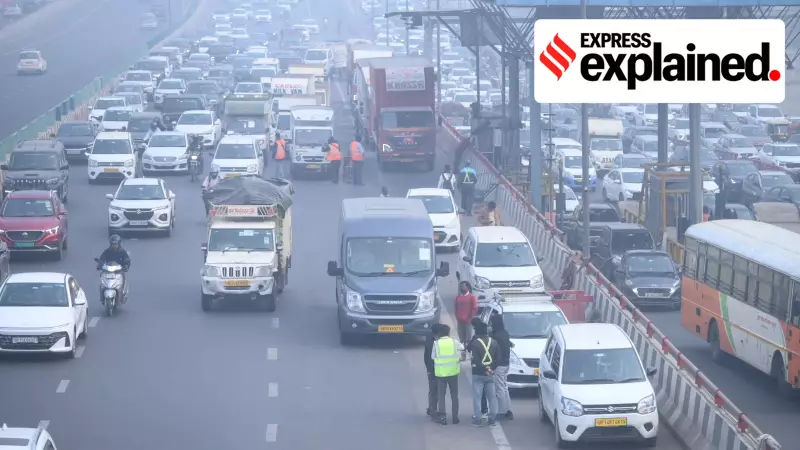
In a decisive move to combat the capital's hazardous air quality, the Delhi government has initiated a stringent enforcement drive targeting vehicular pollution. The crackdown, which began a day after tighter curbs were announced, has brought Bharat Stage (BS) emission norms into sharp focus for drivers across the National Capital Region.
What Are the New Delhi Vehicle Restrictions?
The government has imposed a ban on the entry of non-BS VI private vehicles registered outside Delhi. Furthermore, fuel pumps within the city have been instructed to sell petrol and diesel only to vehicles possessing a valid Pollution Under Control Certificate (PUCC). The penalties are severe: non-compliant cars can be stopped from entering Delhi and slapped with a fine of Rs 20,000. Even BS-VI compliant vehicles are not immune; they can be fined Rs 10,000 if found without a valid PUCC.
How to Check if Your Vehicle is BS VI Compliant
For vehicle owners, confirming your car's emission standard is crucial to avoid penalties. Here are the primary methods to check BS compliance:

The most reliable document is your vehicle's Registration Certificate (RC), which explicitly mentions the emission norm under which the vehicle was certified. As a general rule, vehicles registered on or after April 1, 2020, are BS VI compliant, as this was the date the standard became mandatory across India.
Manufacturers also indicate BS-VI compliance in the owner's manual, and sometimes on stickers placed near the engine or fuel tank. You can also visit an authorised dealership or service centre, where officials can confirm the compliance status using your vehicle's registration number.
For a digital check, vehicle owners can use the VAHAN portal on the Ministry of Road Transport & Highways website. By entering the vehicle's license plate number, you can access detailed registration information, including the emission norm.
To understand the timeline: Cars purchased before April 2020 are typically BS-IV compliant. Vehicles bought between 2005 and 2010 usually comply with BS-III, while those purchased between 2001 and 2005 adhere to BS-II norms.
Why BS VI Norms Are a Game-Changer for Clean Air
Bharat Stage emission norms are India's regulatory framework for controlling pollutants from motor vehicles. Each successive stage tightens the legal limits on exhaust emissions of harmful substances like carbon monoxide, hydrocarbons, nitrogen oxides (NOx), and particulate matter (PM).
The leap from BS IV to BS VI is particularly significant. For diesel vehicles, BS VI mandates a nearly 68% reduction in nitrogen oxides and an 82% cut in particulate matter emissions. For petrol vehicles, nitrogen oxide limits are about 25% stricter. BS VI also requires the use of much cleaner fuel with ultra-low sulphur content, which is essential for advanced emission-control technologies like Selective Catalytic Reduction (SCR) and Diesel Particulate Filters (DPF) to work effectively.
The Delhi-NCR Pollution Context
This enforcement comes against a grim backdrop. In an October meeting chaired by the Prime Minister's Office, vehicular pollution was identified as a major contributor to the air quality crisis. Officials noted that a staggering 37% of vehicles in the Delhi-NCR region are heavily polluting, as they comply only with the outdated BS I, II, or III norms.
Delhi has a history of implementing stricter norms ahead of the nation. It introduced BS II in 2001, BS III in 2005, and BS IV in 2010, years before the nationwide rollout. BS VI was also implemented in Delhi-NCR earlier than the rest of the country. However, as vehicles from other states enter daily, the capital's roads remain a mix of vehicles operating under different, and often older, emission standards.
Older vehicles, especially diesel ones, are disproportionately harmful. They emit high levels of NOx and fine PM 2.5 particulate matter, which are directly linked to respiratory and cardiovascular diseases. The black carbon from their exhaust not only worsens smog but also contributes to climate warming.

The current drive at borders like Ghazipur underscores a critical effort to curb this major pollution source, pushing for a cleaner fleet on Delhi's roads and setting a precedent for urban air quality management in India.