

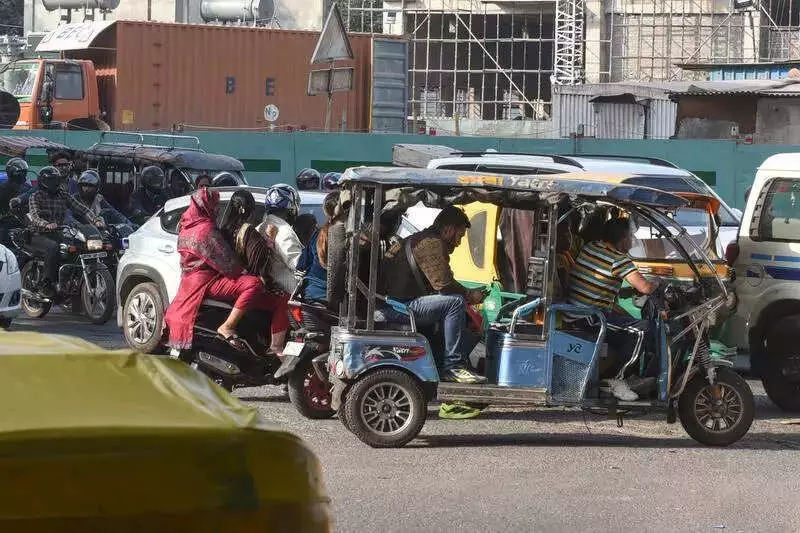
The promise of better connectivity with every new metro station in Delhi is being met with growing anxiety in neighbourhoods along the upcoming corridors. Residents fear that the convenience of the metro could be overshadowed by an unchecked influx of e-rickshaws, leading to severe traffic chaos and clogged local streets.
Neighbourhoods Brace for Impact
In south Delhi's upscale areas of Kishangarh and Vasant Kunj, where e-rickshaws are currently barred from plying on internal residential roads, the concern is particularly acute. Both localities are set to receive stations on the Golden Line (Tughlaqabad-Aerocity corridor) as part of Delhi Metro's ambitious Phase-IV expansion. These new stations will directly serve areas that currently depend on the Yellow Line's Chhatarpur station and nearby Magenta Line stations.
The expansion highlights a critical urban challenge: last-mile connectivity. Officially, Delhi has around 1.2 lakh registered e-rickshaws, but transport experts estimate the actual number is nearly double due to weak regulation and enforcement. Their disruptive presence is most visible near existing metro stations and busy commercial hubs, which have gradually morphed into informal e-rickshaw terminals.

A Cycle of Congestion and Chaos
Residents dread a repeat of a familiar, frustrating pattern. Even with restrictions on major arterial roads like Lala Lajpat Rai Marg or Mehrauli-Gurgaon Road, a new metro station acts as a magnet for e-rickshaws, overwhelming surrounding streets. The scene is often one of disorder: vehicles line up haphazardly with engines idling, drivers call out destinations, and commuters weave through live traffic. Narrow residential lanes, never designed for such volume, quickly choke, creating gridlock, noise pollution, and significant safety risks for pedestrians.
Data underscores the escalating problem. By July 2025, e-rickshaw-related violations had nearly tripled over two years, with a staggering 2,96,772 recorded cases. Officials confirm a significant share of these violations occur in the vicinity of metro stations.
Sunil Raswant, a Vasant Kunj resident, points to the "absolute mess" at the nearby Chhatarpur metro station as a cautionary tale. "The chaos is evident. Irrespective of parking arrangements, there is simply no space for commuters even to stand while waiting for buses," he said. He attributes major congestion at CDR Chowk to unregulated e-rickshaws and advocates for promoting bus services and pedestrian infrastructure instead.
Another resident, Amit Aggarwal, stresses the need for effective integration. "Last-mile connectivity should be efficient and comfortable for all commuters. The problem arises when it remains unregulated," he warned, suggesting that metro stations require multiple, well-planned entry and exit points to prevent e-rickshaw movement from concentrating at a single spot.
Experts Call for Coordinated Action
Urban transport specialists echo these ground-level concerns. Ashok Bhattacharjee, former director of the urban planning body UTTIPEC, acknowledged that e-rickshaws are an affordable and suitable last-mile option but highlighted a failure in coordination. "The real issue is ground-level implementation. Unregulated operations and unauthorised parking create problems. If designated parking is marked and enforcement is consistent, the system can work," he stated.
He emphasised that successful multi-modal integration demands coordinated action from all agencies during planning, implementation, and enforcement phases—a synergy often missing in Delhi.
Enforcement remains a key hurdle. Delhi Traffic Police officials admit that since e-rickshaws are not fully covered under the Motor Vehicles Act, their options for issuing penalties are limited. "On already congested roads, they become an added burden," an officer said, suggesting that capping their numbers at each station could help.

Planning authorities maintain that protocols are in place. A Delhi Metro Rail Corporation (DMRC) spokesperson stated that station locations are finalised after detailed traffic surveys and that multi-modal integration plans are prepared following UTTIPEC guidelines. A UTTIPEC official added that mobility management plans are mandatory from the planning stage itself. However, they clarified that accountability for on-ground execution lies with the implementing agencies, not the planning body.
The warning from urban planners is clear: unless coordination between planning, enforcement, and on-ground management improves substantially, Delhi's new metro stations under Phase-IV risk repeating the old mistakes of congestion and chaos, turning a promise of connectivity into a problem of clutter.





