

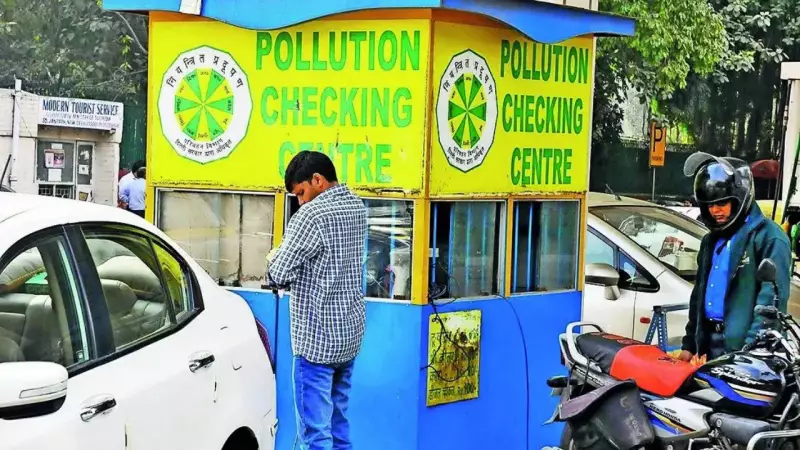
A day after the stringent enforcement of BS-VI norms and the mandatory 'No PUC, No Fuel' rule at Delhi's border entry points and petrol pumps, a noticeable shift in commuter behavior emerged on Friday. While awareness and voluntary compliance showed signs of improvement, the rule's impact was uneven across the city, with reports of dipping fuel sales in border areas and inconsistent checks at some outlets.
Voluntary Compliance Rises Amid Sales Dip
According to Nischal Singhania, president of the Delhi Petrol Dealers' Association, there was a positive trend of customers proactively presenting their Pollution Under Control certificates before refueling. "Customers are themselves taking out their PUC certificates while coming to refuel. This is a positive sign," Singhania told PTI.
However, this newfound awareness came with an economic side effect. Singhania reported that fuel sales had taken a hit in some border areas, with pump owners in Badarpur noting a decline. He attributed earlier uncertainty about the rule's duration but clarified that it would remain in force as long as the Graded Response Action Plan (GRAP) Stage-IV restrictions are active.

Uneven Enforcement Across the City
Despite the official push, the enforcement of document checks was not uniform. Commuters at several petrol pumps reported no verification was carried out. Piyush, a customer at a pump on Rohtak Road, said he bought fuel without being asked for his PUC and observed no police presence. Another commuter, Bhushan Singh, described the situation at his usual pump as "like any other day," indicating a gap in implementation.
Strategic Checks and Evasion Attempts at Borders
Meanwhile, a significant enforcement drive was visible at key city entry points. Teams from the traffic police and transport department were deployed at borders, toll plazas, and petrol pumps to verify PUC certificates and BS-VI compliance.
More than 100 teams of the Delhi Traffic Police have been stationed at vulnerable points, including expressways and highways. A senior officer explained the strategy of placing teams near toll plazas: "Drivers automatically reduce their speed when they see enforcement teams close to toll points. It becomes easier for traffic personnel to stop vehicles smoothly and check papers without causing major traffic disruption."
The scene at the Bijwasan toll plaza on the Dwarka Expressway was telling. Many motorists, spotting barricades and personnel just ahead of the toll, slowed down abruptly. A noticeable number of cars took sudden U-turns to head back towards Gurugram, attempting to evade inspection. This caused brief congestion as drivers assessed the situation and chose to turn back.
The officer emphasized an awareness-driven approach, noting that information boards explaining GRAP-IV rules have been placed at various Delhi-UP and Haryana-Delhi borders. "The idea is to ensure compliance through awareness, not just penal action," he said. Traffic personnel used smart number plate recognition devices at intersections to verify documents and issue challans, even as some motorists pleaded for leniency during the checks.
The overall picture remains mixed: while the rule has successfully increased consciousness about vehicle pollution norms, its on-ground execution and economic impact, particularly in peripheral areas, are still evolving.






