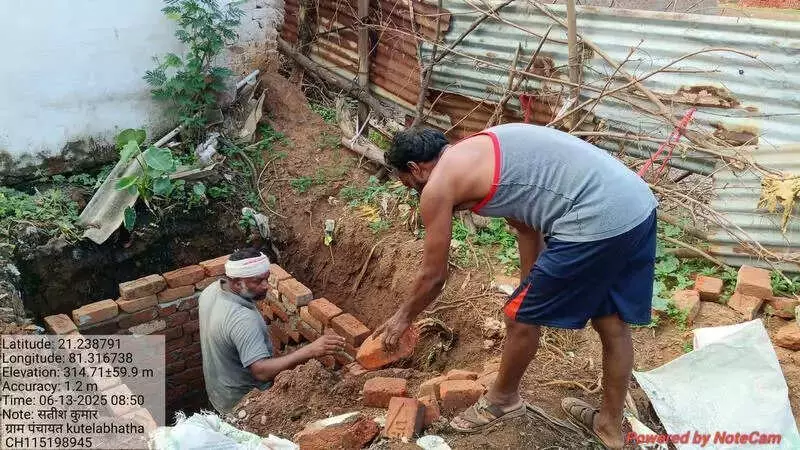
In an inspiring display of community-driven environmental action, the 'Mor Gaon-Mor Paani' campaign in Chhattisgarh's Durg district has evolved into a powerful mass movement. Residents, spearheaded by determined women's groups, have taken water conservation into their own hands, constructing approximately 10,000 soak pits through sheer self-motivation. This monumental effort has not only promoted rainwater harvesting but also saved the state exchequer an estimated Rs 4 crore.
Grassroots Mobilization and Women-Led Initiative
The heart of this success story lies in the active participation of local communities, particularly Women Self-Help Groups (SHGs). Groups including Ruchika, Satyam, Jeevika, Ujjwala, Sakhi Saheli, and Vaishnavi became the campaign's driving force. They led the construction efforts at individual homes and public spaces, demonstrating exceptional leadership in water management. Their work ensured that rainwater harvesting structures were built within Pradhan Mantri Awas Yojana (PMAY) housing complexes and on school premises, integrating conservation directly into community infrastructure.
Record-Breaking Numbers in Water Conservation
The scale of achievement in Durg district is setting new benchmarks for water conservation in the region. Construction is currently in full swing for soak pits in 4,312 PMAY houses, with a detailed breakdown of 2,115 in Dhamdha block, 942 in Durg block, and 1,255 in Patan block. Furthermore, the campaign has already seen the completion of 1,105 soak pits within village school premises. Beyond these targeted sites, the women's SHGs have been prolific, preparing over 5,000 additional soak pits at various residential compounds. Each pit is designed to effectively channel precious rainwater into the ground, directly combating groundwater depletion.

Impact and a Model for the Future
The campaign's impact is twofold: significant environmental benefit and substantial fiscal savings. By choosing a community-owned model, the district has bypassed large contractor-led expenses, leading to the estimated Rs 4 crore saving for the state. More importantly, it has fostered a deep sense of ownership and awareness about water security among villagers. The 'Mor Gaon-Mor Paani' initiative stands as a replicable model, proving that when local communities, especially women, are empowered, they can engineer sustainable solutions to critical issues like water scarcity. The district has indeed set a remarkable record, turning everyday citizens into champions of groundwater recharge.