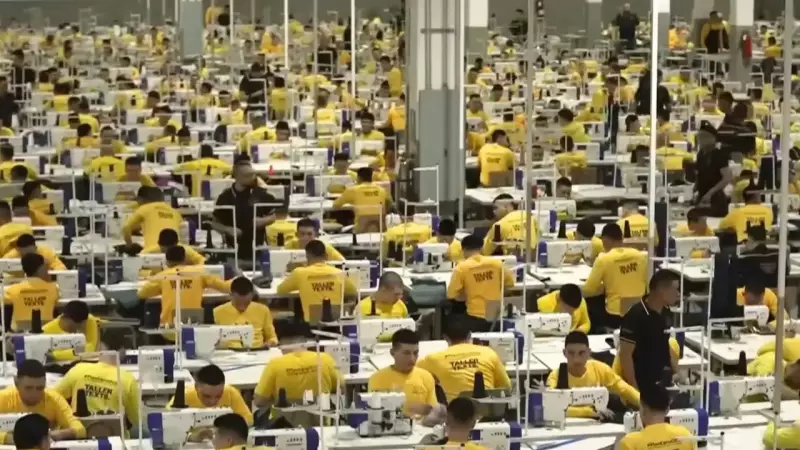
In the heart of El Salvador's vast prison complexes, a new rhythm has taken hold. Rows of sewing machines hum continuously, operated by inmates working in day and night shifts. This is the face of a state-backed prison labour programme that saw a significant expansion in early 2025 under President Nayib Bukele's administration.
The Mechanics of the Prison Factory System
The initiative is framed by officials as a dual-purpose strategy. It aims to make the penitentiary system more functional while providing inmates with structured work, basic vocational training, and a tangible chance to reduce their sentences. For a system historically plagued by severe overcrowding and instability, supporters hail this as a practical move to instil routine and impart skills.
Thousands of detainees rotate through non-stop shifts, their primary output being uniforms for the nation's police, soldiers, and other public sector workers. The workshops run with military-like precision, featuring strict supervision, clearly defined roles, and rigid schedules. The core incentive for participation is the earning of sentence credits, though Salvadoran authorities have not publicly detailed a single, standardised formula for calculating these reductions.

Claims circulating on social media and in some local reports suggest a "two-for-one" scheme, where one day of work counts as two days off a sentence. While authorities confirm that prison labour can lead to reduced time served, they have stopped short of verifying this specific ratio, leaving the exact mechanics purposefully unclear.
Expansion Amidst a Growing Prison Population
This factory system has grown in parallel with the explosive increase in El Salvador's incarcerated population. This surge is a direct result of the government's relentless crackdown on gang violence, which has filled newly constructed mega-prisons with tens of thousands of detainees. The textile workshops are just one component of a broader prison labour network that also includes construction and maintenance work, both inside and outside prison walls.
Beyond rehabilitation, the programme has a clear economic angle for the state. By producing uniforms in-house, the government seeks to slash procurement costs and reduce dependence on private contractors. Proponents argue this allows the prison system to partially offset its operational expenses while keeping a massive inmate population productively engaged.
Global Scrutiny and Potential Model for Reform
Videos from inside these prison factories, widely shared online, have sparked intense global interest. Many international observers express a cautious admiration for the visible order and discipline. The focus for others is on the programme's potential to lower recidivism rates by providing work and purpose.
The Salvadoran model has ignited conversations among policymakers and commentators abroad. Some suggest that similar, carefully regulated work-based initiatives could offer valuable lessons for prison reform efforts in other nations struggling with overcrowding and rehabilitation. The blend of austerity, discipline, and purported redemption continues to be watched closely as a radical experiment in carceral management.