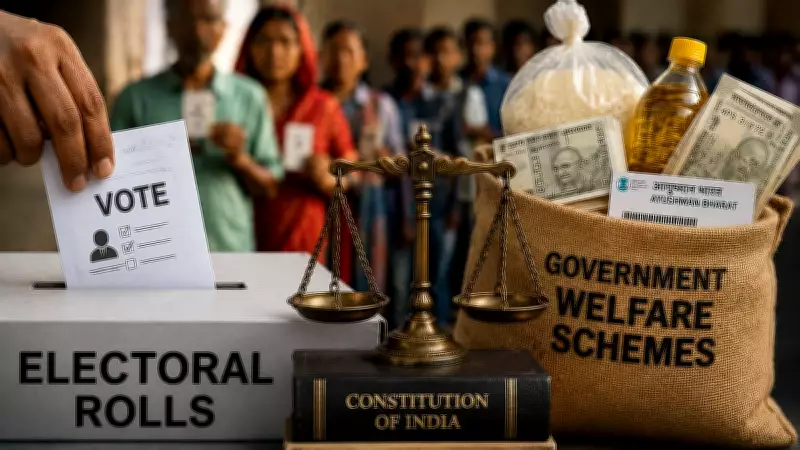
The right to vote is a statutory right, not a mandatory civic obligation. Consequently, failure to be enrolled cannot attract penalties that Parliament itself has never prescribed. This principle, as argued in a recent editorial, underscores the fundamental distinction between a civic duty and a legal entitlement.
Welfare Benefits and Electoral Rolls
The editorial highlights a growing concern: the linkage of welfare benefits to electoral roll enrollment. Some state governments have considered or implemented policies that condition access to welfare schemes on being listed in the electoral rolls. Such measures, the editorial contends, are legally and ethically problematic.
Parliament has never mandated enrollment in electoral rolls as a prerequisite for receiving welfare benefits. The Representation of the People Act, 1951, which governs elections, does not impose any such condition. Therefore, any attempt to gatekeep welfare through electoral rolls exceeds the statutory framework.

Legal and Constitutional Implications
The editorial points out that the right to vote is not a fundamental right but a statutory right under Article 326 of the Constitution. However, this does not diminish its importance. The Constitution ensures universal adult suffrage, and Parliament has the power to regulate elections. But it has not chosen to penalize non-enrollment.
Penalizing citizens for failing to enroll would require explicit legislation. Without it, administrative actions that deny welfare based on electoral roll status lack legal backing. The editorial warns that such practices could disenfranchise vulnerable populations who may not have updated their enrollment.
Impact on Vulnerable Groups
The editorial notes that the most affected by such policies would be the poor, migrants, and marginalized communities. These groups often face barriers to enrollment, such as lack of documentation, mobility, or awareness. Denying them welfare due to electoral roll omissions would exacerbate inequality.
According to the editorial, the special intensive revision of electoral rolls is meant to ensure accuracy, not to serve as a welfare filter. The Election Commission conducts such revisions to clean up duplicates and errors, not to create a new condition for benefits.
Conclusion
The editorial concludes that electoral rolls cannot be used as a gatekeeping mechanism for welfare. The right to vote is a privilege, not a burden. Citizens should not be penalized for exercising or not exercising that privilege. Any attempt to do so would be an overreach by the executive, requiring parliamentary approval. The editorial calls for a clear separation between electoral processes and welfare delivery.