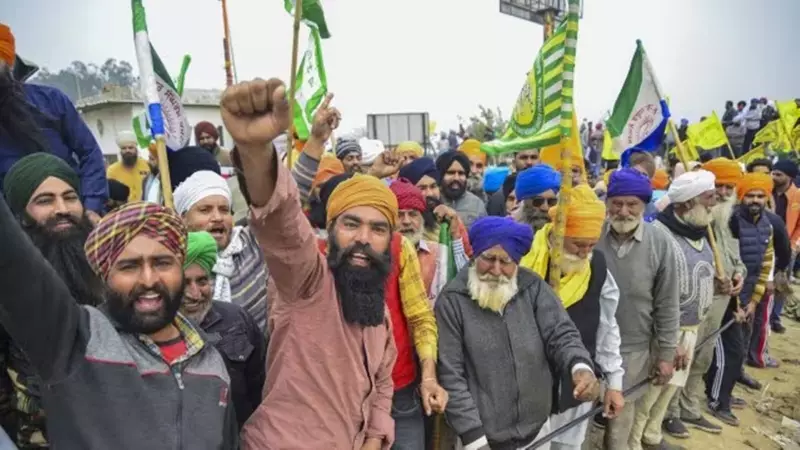
In a significant development, the Samyukta Kisan Morcha (non-political) has formally urged a Supreme Court-constituted expert panel to recommend a legal guarantee for Minimum Support Price (MSP). The farmers' body has demanded that the government either procure all 22 crops covered under MSP or stand as a guarantor to ensure farmers receive the declared price.
Historic Meeting After Year-Long Boycott
The panel, led by retired Justice Nawab Singh, held its first direct meeting with farmer representatives on Friday at its office in the PWD Rest House, Panchkula, Haryana. This meeting came after over a year since the panel's constitution and more than 30 sessions with other stakeholders, during which farmer organizations had boycotted its invitations.
The panel was constituted by the Supreme Court in September 2024. Its interim report is now ready and is expected to be submitted to the apex court shortly, having previously submitted a preliminary report last year.

Core Demands: Legal Backing and Full Procurement
Led by SKM (non-political) chief Jagjit Singh Dallewal, farmer leaders from Punjab, Haryana, Rajasthan, Gujarat, Telangana, and Tamil Nadu presented a strong case. They argued that farmers are not even receiving the assured MSP for crops supposedly covered under the existing scheme, linking financial distress directly to farmer suicides.
Dallewal explicitly appealed to the panel, stating, "We urge you to recommend the legal MSP guarantee on all crops. We know the governments will not accept it. But we want the experts to at least recommend it." He added that such a recommendation could empower farmers to pressure the government through protests.
When panel member and economist R.S. Ghumman asked if farmers wanted government procurement or just an MSP guarantee, Dallewal insisted on full procurement. Haryana leader Abhimanyu Kohar suggested the government could act as a guarantor as an alternative. Dallewal later clarified that the core concern was uniform: no crop should be sold below MSP, regardless of the buyer.
Debunking the "Myth" of Fiscal Burden
The farmer leaders strongly countered arguments that a legal MSP would impose an unsustainable burden of around Rs 2 lakh crore on the exchequer. Kohar presented data showing that India imported crops worth Rs 2.58 lakh crore last year, including edible oil (Rs 1.61 lakh crore), pulses (Rs 47,000 crore), and cotton (Rs 65,000 crore).
"Why cannot these be grown in India? This will also help diversification," Kohar questioned. Dallewal echoed this nationalistic economic argument, stating, "We are farmers and we are also Indians. Why should India's money go out? It should rather stay here." He cited increased cultivation of oilseeds in Punjab, Haryana, and Rajasthan during COVID-19 import disruptions as proof of potential.
Ground Realities: MSP Failure Across States
The meeting provided a platform for farmers from various states to highlight systemic procurement failures. Dallewal rejected the notion that Punjab farmers reliably get MSP for paddy, citing districts like Tarn Taran, Gurdaspur, and Amritsar where prices are much lower. He alleged manipulation of moisture content readings to justify lower payments.
Farmers from Uttar Pradesh reported that while paddy fetches a good price in the NCR region, it sells for as low as Rs 900-1,100 per quintal in Purvanchal. A Gujarat farmer, Gajendra Singh Jal, stated cotton prices have fallen from Rs 9,000 per quintal in 2010 to Rs 7,000 now. Sandeep Singh from Rajasthan said moong is sold at Rs 4,500 per quintal against an MSP of Rs 8,768.
Kohar raised a critical governance issue, revealing that over the past five years, the Finance Ministry allocated Rs 1 lakh crore to the Agriculture Ministry, but a major portion was returned unused. Justice Nawab Singh shared his personal experience as a moong farmer in Haryana, facing an arbitrary procurement cap of 3.5 quintals per acre against his yield of 5 quintals per acre.
A Positive Start and Future Engagements
The meeting began on a conciliatory note, with Justice Nawab Singh recalling that farmers did not block the Ambala-Delhi highway during the 2025 Shambhu border protest; the government had barricaded it. Dallewal thanked him for "exonerating" the farmers.

The panel chairperson assured farmers ample time to present their views and invited them for further discussions. This first engagement is expected to encourage other farmer groups, like the Kisan and Mazdoor Morcha led by Sarvan Singh Pandher (which had previously refused to meet), to participate.
The SC panel has already consulted experts from NABARD, Niti Aayog, the Commission for Agricultural Costs and Prices (CACP), and officials from Punjab and Haryana. The inclusion of direct farmer testimony marks a crucial phase in its deliberations on one of Indian agriculture's most contentious and enduring issues.