On December 31, 2025, a significant protest unfolded across India's urban landscape. Gig and platform workers, the invisible force behind countless food and parcel deliveries, declared a strike. Their call was simple yet powerful: log off from the apps. This collective action was a direct protest against what they termed exploitative working conditions, inhuman treatment, and a glaring absence of social security nets.
The Muted Strike and the Unchanged Reality
While delivery platforms quickly countered by announcing record delivery numbers, attempting to downplay the strike's impact, the fundamental issues raised refused to be silenced. The protest may have received a muted public response, but it cast a harsh spotlight on a persistent crisis in the modern world of work. Governments globally are grappling with a fundamental question: how do you define and regulate work when it is mediated through a smartphone app?
The core of the conflict lies in the nature of the contract—or often, the lack thereof. App-based aggregators consistently refuse to be classified as employers, despite utilising the services of these workers to deliver their core goods and services. This fundamental denial of an employer-employee relationship creates a legal vacuum, making existing labour laws and social protection measures nearly impossible to apply.

In practice, these workers perform tasks dictated by the corporations. However, they are almost universally treated as 'self-employed' or glorified as 'partners.' This label is a mirage. As Associate Professor Himanshu from JNU points out, these so-called partners have no insight into the company's profits, functioning, or decision-making processes. The relationship is shrouded in opacity, which corporations exploit without consequence.
Algorithmic Control and the Absence of Rights
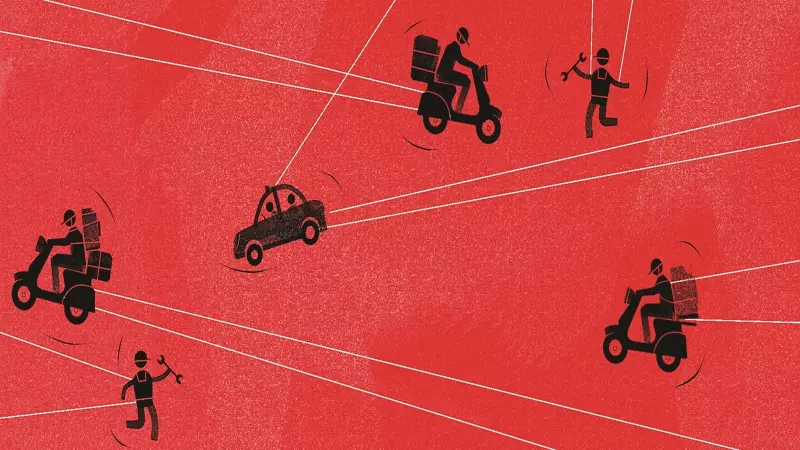
The day-to-day reality for a gig worker is governed by an inscrutable algorithm. The incentive structure often encourages self-exploitation, pushing workers to take on more risks for meagre rewards. Any deviation is punished by the same opaque system. There is no transparent grievance redressal mechanism, leaving workers subservient.
Forget social security provisions like pension or health insurance; even basic wage compensation is algorithmically determined, with zero tolerance for errors. In the event of sickness or an accident, the worker bears the entire risk and financial burden. They are governed by no limits on working hours and are eligible for no paid leave or benefits.
This regulatory black hole is not solely the fault of corporations. Government policy has also failed to keep pace. Take the four labour codes enacted in 2020. The most fundamental one, the Code on Wages, excludes gig workers. They find a mention only in the Code on Social Security, but even here, it is without corresponding enforceable rights. The obligation for platforms is merely to contribute to a social security fund, with no clear commitment to treating workers as employees with rights.
A Path Forward: Recognition is the First Step
In a country with massive unemployment, gig work is not disappearing. It has created a new class of casual workers, whose conditions are as precarious as those of manual labourers, if not worse. The tepid response to the December strike from the urban middle class—the biggest beneficiary of these services—shows that public pressure may not force change. The platforms themselves are unlikely to voluntarily alter a profitable model.
This impasse underscores the critical role of the government. The first and most crucial step is legal recognition: classifying gig workers as 'workers' and the platforms as 'employers.' This is not a radical idea. Several countries in the Global North, and even in the Global South like Mexico and Brazil, have moved in this direction.

In India, states like Rajasthan have enacted laws, and Karnataka has proposed legislation. However, these efforts have not gone far beyond mandating corporate contributions to social security funds. With gig workers forming one of the largest and most vulnerable occupational groups, any meaningful regulation must begin with granting them employee status, ensuring they are covered by the full spectrum of labour rights. Until this happens, the exploitation built into the gig economy model will persist.