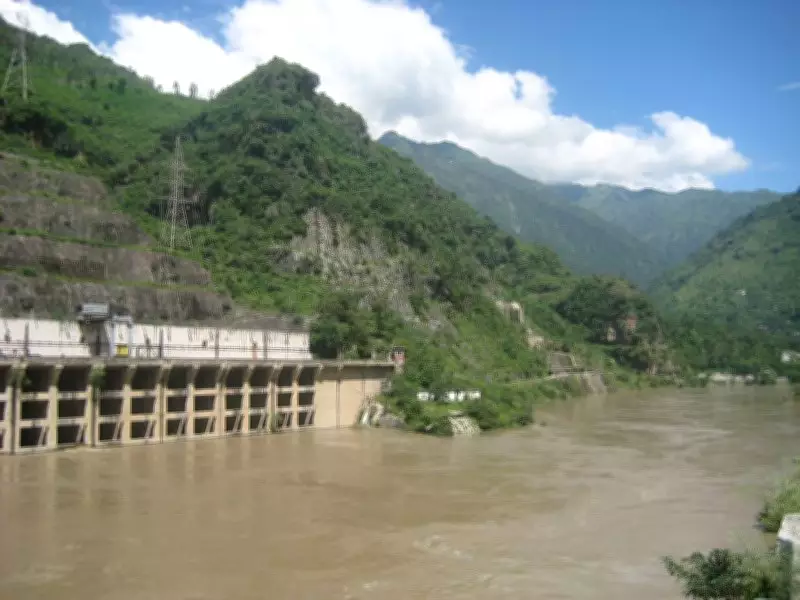
A new study from the Indian Institute of Technology (IIT), Ropar has challenged the Bhakra Beas Management Board’s (BBMB) long-standing estimates of silt accumulation and storage loss in the Gobind Sagar reservoir behind the Bhakra Dam. According to the IIT team, the reservoir has retained significantly more of its original storage capacity than the BBMB has claimed.
Key Findings of the IIT-Ropar Study
Led by Dr Reet Tiwari, the IIT scientists estimate the overall loss of storage capacity at 38 percent, compared to the BBMB’s figure of 47 percent. The loss of live storage stands at just 13 percent, far lower than the BBMB’s estimate of 19 percent. Similarly, the loss of gross storage is pegged at 19 percent, against the board’s 26 percent. The study also revises annual silt inflow downward to 31 million cubic metres (MCM) from the BBMB’s 39 MCM, even lower than the original design estimate of 33.61 MCM per year.
Advanced Survey Techniques Yield Different Results
Senior BBMB officials, speaking on condition of anonymity, attributed the discrepancies to the IIT team’s use of modern bathymetric surveys, drone-based mapping, and much denser cross-sectional measurements. “The IIT scientists conducted surveys at intervals of about 30 metres, capturing finer variations in the reservoir bed, whereas our conventional surveys relied on cross-sections spaced roughly 610 metres apart,” one official told The Tribune. The higher-resolution mapping resulted in more precise sediment estimates.

Implications for the First Major Desilting Plan
The contrasting findings come as the BBMB moves forward with an ambitious plan to mechanically desilt the Gobind Sagar reservoir for the first time since the dam became operational in 1959. The board has floated an expression of interest for desilting at two sites: Lunu in Bilaspur district and Seer Khad in Una district, Himachal Pradesh. Officials estimate nearly 150 MCM of silt is available for excavation at each site. The contractor will be responsible for obtaining environmental clearances and other statutory approvals. Himachal Pradesh will receive a royalty of about Rs 150 per tonne on the extracted material. If the excavated silt yields higher commercial value, additional revenue may be shared among the partner states of Punjab, Haryana and Rajasthan.
Broader Context and Expert Consensus
Despite the differences in storage loss estimates, water management experts agree that sediment control is critical for maintaining the long-term efficiency of the Bhakra project. The dam remains one of northern India’s most vital sources of irrigation water, hydropower generation, and flood moderation. The IIT study underscores the need for ongoing scientific monitoring to inform sustainable reservoir management.
The findings have already prompted calls for a joint review by the BBMB and IIT-Ropar to reconcile methodology and ensure that desilting efforts are based on the most accurate data available. As the board prepares to issue tenders, the debate over the true extent of siltation is likely to influence the scale and cost of the desilting operation.