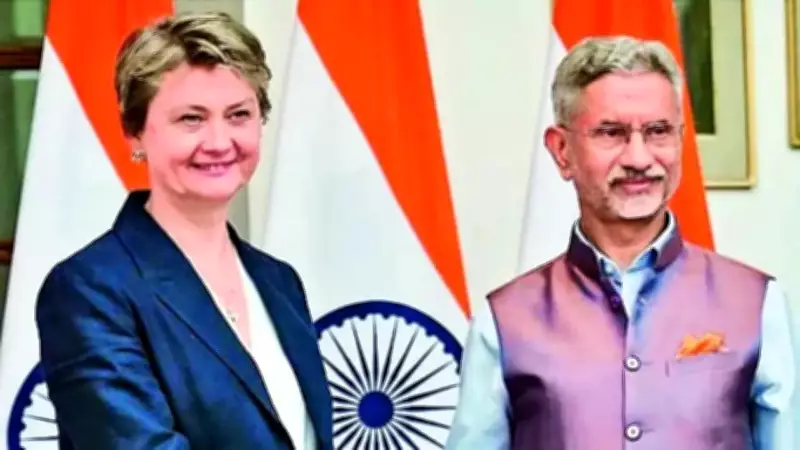
NEW DELHI: During UK Foreign Secretary Yvette Cooper's visit to India on Thursday, both sides announced the launch of a Critical Minerals Global Supply Chain Observatory, marking a significant milestone in their growing partnership on critical minerals and supply chain resilience, according to an Indian readout.
Key Agreements Signed
India and the UK also signed a Memorandum of Understanding (MoU) to establish a Regional Maritime Security Centre of Excellence. This centre will assist Indian Ocean states in building capacity to address non-traditional maritime security threats.
High-Level Meetings
Cooper met her Indian counterpart, External Affairs Minister S Jaishankar, and also called on Prime Minister Narendra Modi. The two sides reviewed ongoing progress in bilateral cooperation, focusing on trade, technology, supply chains, defence, climate, education, and people-to-people ties.

Jaishankar's Remarks
Jaishankar told Cooper that the two countries are well-positioned to construct a new future-oriented and mutually beneficial partnership, building on their newly firmed-up comprehensive trade deal and the defence industrial roadmap. In a post on X, he stated that they discussed new opportunities in clean energy, artificial intelligence, and critical minerals, while exchanging views on global developments, including in Ukraine, West Asia, and the Indo-Pacific.
PM Modi's Statement
Before her meeting with Jaishankar, Cooper called on PM Modi. Modi posted on X: “Appreciated the deepening of the India-UK partnership in recent times that has unlocked unprecedented growth opportunities for both our countries. India-UK Vision 2035 will continue to guide our partnership and strengthen our joint efforts for global good.”
Vision 2035 and Trade Deal
The two sides had launched Vision 2035 last year to work for mutual growth, prosperity, and to shape a “prosperous, secure, and sustainable world in a time of rapid global change.” Jaishankar highlighted the finalisation of the India-UK Comprehensive Economic and Trade Agreement (CETA), the adoption of a comprehensive strategic partnership, and the defence industrial roadmap as major achievements. He noted that CETA addresses concerns about creating resilient supply chains and addressing issues in trade, energy, food, and economic security. “Our ties have moved from being a historical and perhaps cultural connection to being a forward-looking highway of shared economic ambitions and high technology,” he added.