

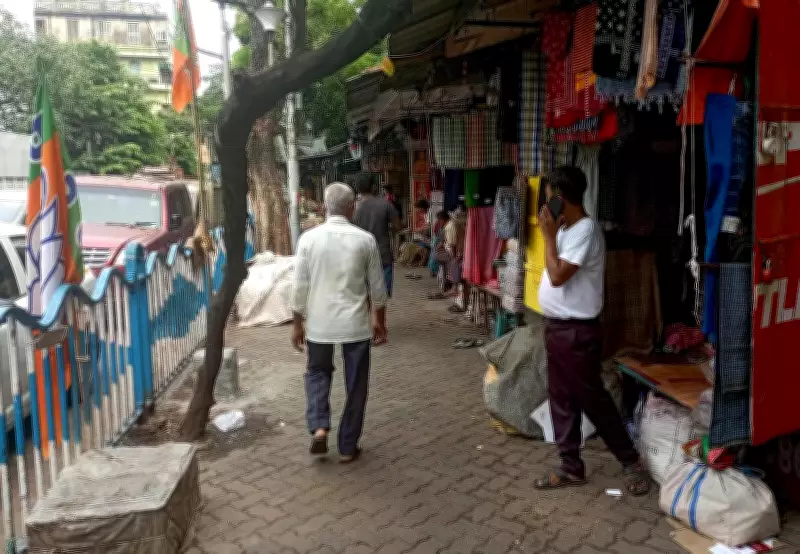
Kolkata: A joint team of Kolkata Police and the Kolkata Municipal Corporation (KMC) carried out a large-scale anti-encroachment drive near Armenian Ghat, on parts of Strand Road, and on the approach road to the Mullickghat flower market on Wednesday and Thursday. The operation, which is believed to be among the largest in recent times, resulted in the demolition of over 200 illegal structures built on government land. Additionally, a push-back drive was conducted on the pavements along S N Banerjee Road on Friday.
Details of the Demolition Drive
Payloaders and demolition equipment were deployed during the operation, with police personnel standing guard to prevent any possible disruptions. Fortunately, no untoward incidents were reported. The demolished structures included a range of encroachments such as shanties, godowns, small eateries, and shops that had been illegally occupying the busy riverfront stretch for years. An official stated that several occupants had also constructed concrete structures on government land without authorization, prompting the authorities to initiate the demolition exercise.
Part of a Wider Campaign
This drive is part of a broader anti-encroachment campaign launched by the new state government across urban areas since it assumed office last month. The scale of the riverfront demolition generated a large volume of debris, much of which remained piled up at various spots. Civic workers continued cleaning up on Friday, removing rubble and construction waste left behind after the structures were demolished.

A police officer involved in the exercise confirmed that the drive was among the largest anti-encroachment operations in the area in recent years. “Over 200 illegal structures were cleared from Armenian Ghat, Strand Road, and the approach to the flower market. Many of those structures had occupied government land for years,” the officer said. “The objective of the drive was to reclaim public space and ensure free movement in the area. We had informed the occupants of the illegal structures beforehand about the demolition drive, and many of them had cleared out their belongings.”
Public Reaction
Commuters and pedestrians welcomed the clearance, noting that encroachments had become a permanent feature of the riverfront landscape. “I have been passing through this stretch for years and I had always found it encroached upon. No one could ever imagine that these shops and structures would ever be removed. The place looks much more open now,” said Amit Das, a frequent user of the route.
However, affected individuals at Armenian Ghat expressed distress over the sudden demolition. “We are not saying the government should not clear the land, but they could have given us some more time to look for an alternative space,” said Shalu Singh, who had lived in a shanty for over 15 years.
Preventing Future Encroachments
Police were stationed at the site to ensure that encroachers did not return. “Monitoring will continue to prevent fresh encroachments from coming up on the reclaimed land,” an officer stated.
Push-Back Drive on SN Banerjee Road
On Friday afternoon, a push-back drive was also conducted on the pavements along SN Banerjee Road near Janbazar. Several traders who had encroached on the pavements were prosecuted. On the southern side of the street, where rows of photo frame shops are located, authorities cautioned owners against keeping their wares on the pavement in front of their shops. Some materials were seized.
“The photo frame shopkeepers used to display frames, up to 5 feet high, outside their shops, which hindered pedestrians’ movements. Those were removed,” said Manish Khaitan, a resident of the area. “The pavement on the other side was also cleared, as obstructions left hardly two to three feet of space for passers-by.”
Mahendra Prasad, a photo frame shopkeeper, said, “Police alerted all traders a week ago and asked us to remove encroachments from the pavement. But hardly anyone paid heed. They faced the consequences on Friday.” Another owner, some of whose wares were seized, added, “We put out these materials on the pavements so that the space is not taken over by new hawkers.”

In the evening, hawkers, mainly vegetable sellers, sat on the pavements with their wares. “We were told to stick to only three feet of the pavement and not beyond. We are obeying the rule,” said Ratan Karat, a vegetable seller.





