

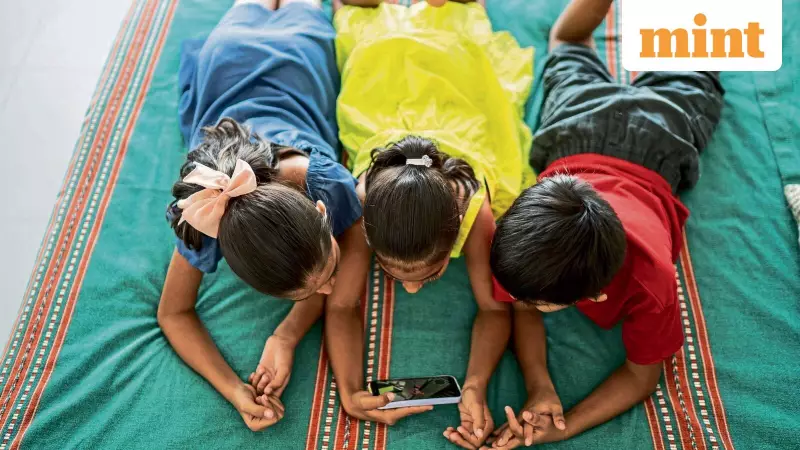
As the new year begins, countless Indian parents are grappling with a common concern: how to effectively reduce their children's screen time. This widespread parental anxiety has now found a powerful echo in the halls of the judiciary.
Judges Propose a Legislative Solution
In a significant development, two judges from the Madurai bench of the Madras High Court have recently urged the Union government to consider enacting a law to restrict children's access to the internet. Their recommendation draws direct inspiration from a recent legislation in Australia, which implemented a ban on social media for users under the age of 16.
The judges' suggestion came while responding to a public interest litigation (PIL) filed in 2018. They highlighted the urgent need for better awareness among both parents and children about the pervasive dangers lurking online. Global studies consistently show that young users are routinely exposed to inappropriate content, face cyberbullying, and are vulnerable to scammers and predators. These experiences can lead to severe consequences, including mental health breakdowns, low self-esteem, body dysphoria, and in extreme cases, suicidal ideation. The judges noted that the risks have been further amplified by artificial intelligence agents abetting such harmful behaviours.

The Global Debate: Are Bans the Answer?
While the world watches Australia's bold move, experts caution that outright bans are not a foolproof solution. History shows that prohibition alone cannot eradicate complex social issues. If it could, the world would be free of drugs and crime. Furthermore, such measures risk creating more despotic environments without space for dissent.
A major practical hurdle is age verification. Currently, all social media platforms have a minimum age requirement, but the lack of stringent verification tools allows children to easily circumvent these rules. Unicef has warned that a ban could make such circumvention even more ubiquitous. One proposed solution is stricter access via government IDs and biometric details. However, this raises a new set of problems: it could exclude those without official IDs and, more worryingly, deepen the surveillance economy. As scholar Shoshana Zuboff outlined in her book 'The Age of Surveillance Capitalism', such measures could make journalists, activists, and whistleblowers more vulnerable to state overreach and allow data collection from a very young age.
Preparing Gen Alpha for an Inevitable Digital Future
The challenge is particularly acute for Gen Alpha (children under 16), who are born into a world saturated with the internet. From infancy, they see their milestones documented online by parents. Screens are used as pacifiers for tantrums, and public spaces are filled with adults scrolling through phones. With parks being rare in many Indian cities, children often retreat into video games behind locked doors.
Yet, shielding them entirely may be counterproductive. A study by the International Workplace Group suggests that when this generation joins the workforce, many of their colleagues will be robots, and their tools will be fully tech-enabled. Keeping them away from the internet might hinder their ability to build a life. The more sustainable solution, therefore, lies not in isolation but in education. The focus must shift towards training children to become ethical and responsible digital citizens, equipped to navigate their inevitable digital future with awareness and resilience.






