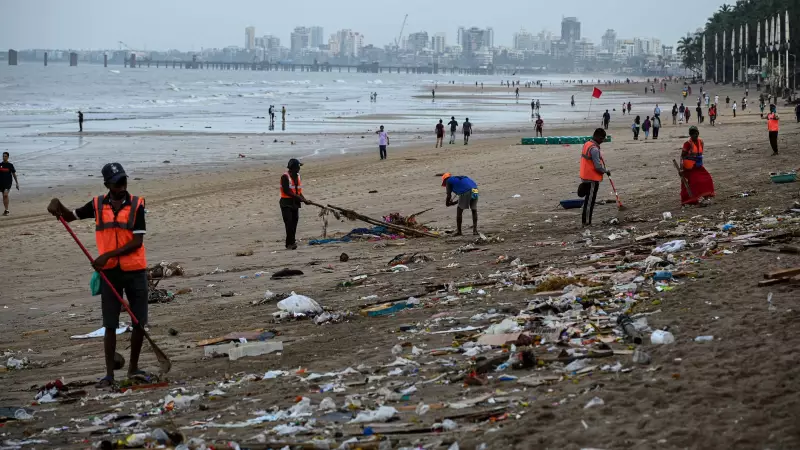
Mumbai has been ranked among the top ten dirtiest cities in India, securing the eighth position in the recently released Swachh Survekshan 2025 report. This alarming ranking has prompted the Brihanmumbai Municipal Corporation to take decisive action with a massive ₹4,000 crore overhaul of the city's waste management system.
In an exclusive interview, Kiran Dighavkar, Deputy Municipal Commissioner of the solid waste management department at BMC, revealed the complex challenges facing India's financial capital and outlined the corporation's ambitious plans to transform how Mumbai handles its garbage.
The Root of Mumbai's Waste Problem
According to Dighavkar, the most significant obstacle to cleanliness in Mumbai isn't technical or financial—it's behavioral. "The biggest challenge for Mumbai is behavioral patterns among its public," he stated, drawing comparisons from his recent study tour in Singapore where mechanical sweeping occurs only once daily, even on Sundays.

The situation in Mumbai presents a stark contrast. Nearly 50 percent of Mumbai's population resides in informal settlements where garbage generation happens round the clock. Unlike organized residential societies with specific waste collection timings, slums experience continuous production and disposal of garbage at community spots.
Dighavkar highlighted the city's unique challenges: "Mumbai runs 24X7, so the city generates garbage every hour. Even with 30,000 laborers cleaning streets daily, bins refill within two hours." The floating population exacerbates the problem—in A ward alone, the daytime population swells to 40 lakh from a nighttime count of just 1.65 lakh.
The ₹4,000 Crore Transformation Plan
The BMC's massive tender for 'service-based waste management' represents a fundamental shift in approach. For the past 15 years, the corporation hired vehicles from contractors while using its own laborers for garbage collection. This split responsibility created accountability issues and inefficiencies.
Under the new system, contractors will provide vehicles and handle garbage collection, creating single-point accountability. The payment structure changes from shift-based to weight-based, incentivizing maximum waste collection. The plan also includes phasing out 15-year-old compactors with higher-capacity vehicles featuring new designs, colors, and patterns.
Addressing concerns about privatization and job security, Dighavkar assured that 5,000 motor loaders will be reassigned to cleaning and second sweeping duties without losing benefits, following formal agreements with workers' unions.
Tackling Waste Segregation and Construction Debris
Waste segregation remains an elusive goal for Mumbai. The new plan addresses this through dedicated dry waste collection vehicles in each ward and modernizing 46 operational dry waste segregation centers. The Development Plan 2034 reserves space for 96 such centers where automated segregation will enable recycling and reselling.
Construction and demolition waste has emerged as a critical concern, with Mumbai generating 8,000 metric tonnes daily—surpassing the city's regular garbage output of 7,000-7,500 metric tonnes. This unauthorized dumping contributes to dust pollution, mangrove destruction, and drain siltation.
Dighavkar emphasized that construction waste management will be a top priority, with plans to augment treatment facilities aligned with the draft Solid Waste Management Rules of 2025.
Changing Public Behavior: The Ultimate Challenge
The official pointed to recent regulatory changes that redefine waste ownership. "The name 'municipal waste' has been changed to simply 'waste', meaning waste is owned by the people, not just the municipal body," he explained, referencing the extended producers' responsibility concept in the 2025 solid waste management bylaws.
This philosophical shift places responsibility on waste generators, from individual citizens to large-scale construction projects. However, Dighavkar acknowledged that behavioral change in a metropolis of Mumbai's scale remains enormously challenging.

As Mumbai grapples with its cleanliness ranking, the comprehensive approach combining infrastructure upgrades, regulatory changes, and public awareness campaigns represents the city's best hope for transforming its waste management landscape and reclaiming its status as a clean metropolitan hub.