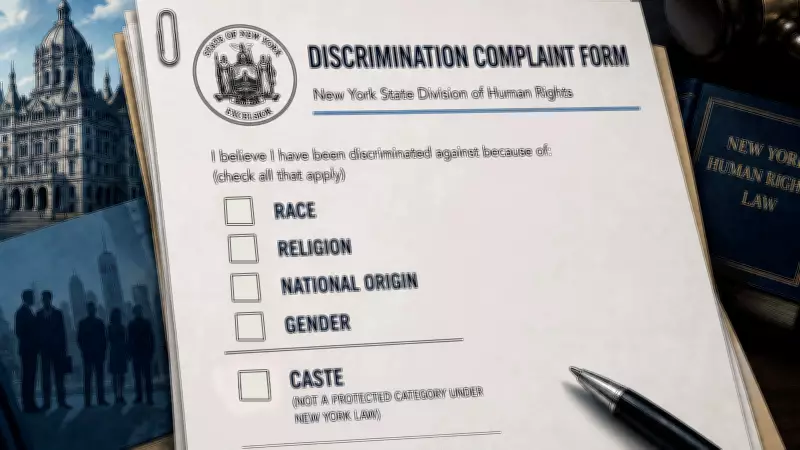
After nearly 15 months of lobbying and pushback, New York's attempt to explicitly ban caste bias has hit a wall. The bills — Senate Bill S6531 and Assembly Bill A6920 — would have added caste as a protected category under New York's Human Rights Law, making it unlawful to deny someone a job, housing, credit, educational institutions, or access to public spaces because of caste.
However, both bills remained stuck at the committee level when lawmakers wrapped up the regular 2026 legislative session in early June. In New York, a bill does not go directly from introduction to a full vote. It is first sent to a committee, a smaller group of lawmakers that decides whether the proposal is ready to move forward. The committee can hold hearings, amend the bill, reject it, or "report" it to the full Senate or Assembly for a floor vote. That last step never occurred. The bills did not reach the full Senate or Assembly, did not go to the governor, and did not become law. They were also not formally voted down.
New York operates on a two-year legislative term, so bills introduced in 2025 can carry into 2026. With the regular session over, the ordinary route to passing them this year has closed unless lawmakers return to the issue later in 2026. If the bills remain unfinished when the 2025-26 term ends on December 31, 2026, they will lapse. To bring the proposal back after that, lawmakers would have to file new versions, obtain new bill numbers, and start again in 2027. Thus, the bills are not officially dead, but the delay is serious.

What Did the Bills Say?
The bills were civil-rights measures, not criminal-law measures. They were not New York's version of India's SC/ST Act and would not have created a new caste crime, jail term, or special criminal punishment. Instead, they would have changed the state's anti-discrimination law.
The bills defined caste as a "class in a graded social hierarchical structure" that assigns people status, roles, privileges, and disadvantages by birth. The definition also referred to hereditary status, endogamy, occupational restrictions, limits on mobility, and unequal access to rights or opportunities. In practical terms, the bills would have inserted "caste" into parts of New York's Human Rights Law covering jobs, housing, credit, internships, real estate transactions, labor organizations, occupational training, and public accommodations — meaning places and services open to the public, such as restaurants, shops, hotels, and transport services.
If passed, a person could file a complaint stating they were denied work, housing, credit, an internship, or public services because of caste. Without the word "caste" in the law, a complainant must argue that caste bias fits indirectly under categories such as race, religion, national origin, or ethnicity. The bills aimed to remove that extra step. Their core idea was simple: if caste can shape treatment within diaspora communities, New York law should name it directly.
Why Were They Introduced?
The New York campaign grew out of a 2018 case filed by Swati Sawant, a Dalit immigration attorney. She represented a Dalit Nepali asylum seeker who had worked at an Indian restaurant in New York City. According to the complaint, his caste became known through his surname, after which he allegedly faced exclusion, caste-based comments, and harassment. When he complained, he was terminated.
The New York State Division of Human Rights dismissed the case because caste was not a protected classification under the state Human Rights Law. For Sawant, that exposed the gap the bills were meant to close. "I filed the first caste discrimination case in New York in 2018 and watched it get dismissed — not because caste discrimination didn't happen, but because our law had no language to address it," she said.
Sawant turned the dismissal into an advocacy campaign, working with Assemblymember Steven Raga's office before the proposal reached Albany. Senator James Sanders Jr. introduced the Senate bill on March 17, 2025, and Raga introduced the Assembly version the next day. (New York has two lawmaking chambers, like India's Lok Sabha and Rajya Sabha — the Senate version was the bill filed in the upper chamber, and the Assembly version was the same proposal filed in the lower chamber.)

Why Weren't They Passed?
The bills encountered three obstacles. Procedurally, neither bill received the committee action needed to reach a full vote. The Senate bill was before the Investigations and Government Operations Committee, while the Assembly bill was before the Governmental Operations Committee. This does not prove the committee chairs opposed them; it means the bills were never advanced to the floor, where all lawmakers would have had to vote yes or no. Consequently, there is no roll call of lawmakers who rejected the proposal. The bills were held up by inaction, not defeated by a recorded vote.
Politically, organized opposition came from Hindu-American and Indian-American groups, especially the Coalition of Hindus of North America (CoHNA). CoHNA urged New York residents to contact lawmakers and oppose the bills, arguing that the word "caste" itself was the problem. "Caste is not a neutral term," CoHNA said. The group argued that naming caste in state law would unfairly mark people of South Asian origin for extra scrutiny in schools, workplaces, and public life. Its proposed alternative was "ancestry," which it said would cover inherited-status discrimination without singling out Hindus, Indians, or South Asians.
Legally, the dispute was over whether caste needed to be named at all. New York's Human Rights Law already bars discrimination on grounds including race, color, creed, national origin, citizenship or immigration status, sex, and disability. The state says national origin can include country of birth, an ancestor's country of birth, ethnicity, and language. CoHNA used that framework to argue that existing law was sufficient. Sawant's 2018 case gave the bill's backers their reply: if caste was already covered, why was that complaint dismissed because caste was not a protected classification? That was the unresolved question when the session ended.
What Has the US Done About Caste Discrimination?
The Migration Policy Institute estimates that about 3.2 million Indian immigrants live in the US, making Indians the country's second-largest immigrant group after Mexicans. Indians are also heavily represented in skilled-worker visas, universities, and technology jobs. As that diaspora has grown, the concern is that caste bias can travel with migrants into American workplaces, campuses, housing markets, and politics.
America does not have one settled answer on caste. No American state has enacted a statewide law explicitly banning caste discrimination. California came the closest. In 2023, the California legislature passed a bill that would have made caste discrimination illegal by placing caste under ancestry in state civil-rights law. However, Governor Gavin Newsom vetoed it on October 7, 2023, arguing that California's existing protections, including ancestry and national origin, already covered caste discrimination.
At the city level, the record is different. Seattle became the first US city to explicitly ban caste discrimination in February 2023. In September of that year, Fresno in California became the second American city to do so. Campuses and companies have also moved faster than many state legislatures. Brandeis University added caste to its non-discrimination policy in 2019. Harvard later added caste bias protections for graduate and undergraduate student workers. Apple also updated its employee conduct policy to explicitly include caste.
The biggest workplace case so far involved Cisco. In 2020, California regulators sued Cisco, alleging that a Dalit engineer had been discriminated against by two Indian-origin supervisors. Reuters reported that the lawsuit accused Cisco of allowing the employee to be harassed because he was from a lower caste than the two managers. Cisco denied wrongdoing and said it had followed its internal process.
At the federal level, caste is not named in Title VII of the Civil Rights Act of 1964, the main US employment discrimination law. Title VII bars discrimination based on race, color, religion, sex, and national origin. A lawyer may argue that caste fits under one or more of those categories, but the word itself is not there. That is the gap New York's bill was trying to address, and it is why caste cases in the US often become arguments about legal classification before they become arguments about what happened.
About the Author: Bhavika Jain is a senior correspondent with The Times of India. While her primary beat is the BMC, she also keeps tabs on stories relating to heritage, environment, and health. When not scouting for news stories, she watches films or tries out new places to eat.