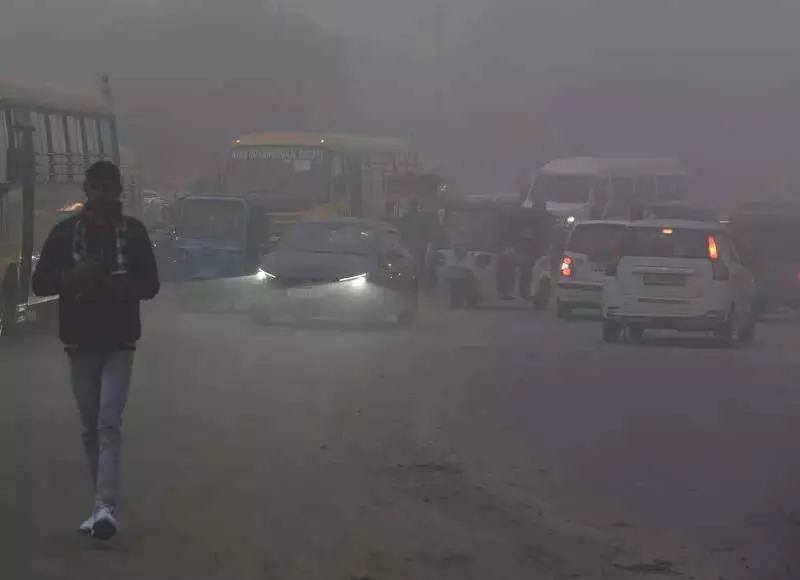
Driving a bus in the dense winter fog of Uttar Pradesh has become a perilous daily gamble for hundreds of drivers. For Manish Kumar, who operates an early morning service from Noida to Agra, the journey is now largely a matter of guesswork and experience.
A Perilous Daily Commute in Zero Visibility
"We typically depart the depot at 5 am aiming to reach Agra by 9 am," Kumar explains. "But the thick fog on the route makes navigation extremely challenging." The entire region, particularly during early mornings and late nights, is enveloped in a dense blanket of smog, causing visibility to plummet sharply. On a recent Monday, visibility fluctuated between a mere 50 meters and 200 meters across the area.
Despite these hazardous conditions, bus drivers continue to risk their lives to transport early morning passengers to their destinations. The Uttar Pradesh State Road Transport Corporation (UPSRTC) Noida depot operates 188 buses connecting Noida with districts like Ghaziabad, Bulandshahr, Meerut, Agra, and Aligarh, as well as on long-distance routes to Lucknow and Dehradun.

The Human and Operational Scale
This massive operation is run by a crew of nearly 500 drivers and conductors, who collectively ferry close to 35,000 commuters every single day. An additional 150 buses operate from the Greater Noida depot to a wider network of destinations including Mathura, Hathras, Hapur, Bareilly, and Jewar.
For the drivers, avoiding work is simply not an option. Most are contractual employees paid approximately Rs 2 per kilometer. "If we drive less, we get paid less," one driver stated bluntly, highlighting the direct impact on their earnings.
The dangers are not theoretical. Aditya, a conductor at the Noida depot, recalled a tragic massive pile-up near Mathura about two weeks ago that claimed 13 lives and left many injured. "Visibility is very poor, but we have to do our duty," he said, echoing the sentiment of his colleagues.
Safety Measures and Infrastructure Gaps
UPSRTC officials state that they have implemented several safety protocols. Rohtash Singh, Assistant Regional Manager of UPSRTC Noida, confirmed that all buses are equipped with fog lights, wipers, and functional indicators. Drivers and conductors have been instructed to maintain speed limits and adhere strictly to traffic rules. As a precaution, night services from Noida to Lucknow have been temporarily suspended due to fog-related risks.
However, drivers and bus operators point to a critical infrastructure shortfall: inadequate lighting on expressways. Shyam Lal Gola, General Secretary of the Delhi Interstate Bus Operators Sangh, noted that hundreds of luxury buses plying between Delhi and Uttar Pradesh face similar issues. "Lighting systems on the Yamuna Expressway and other e-ways are not effective during fog and inclement weather. This needs urgent improvement," he asserted. He also mentioned that towing services are often delayed by hours when a vehicle breaks down on these expressways.
The scale of operations is vast. Ghaziabad alone has a fleet of 1,084 UPSRTC buses running from eight depots, managed by nearly 4,000 staff, handling about one lakh commuters daily. Kesri Nandan, Regional Manager of UPSRTC Ghaziabad, said they have advised all drivers to keep speeds below 50 kmph during winter, avoid roadside parking, and have pasted reflective tapes on buses for better visibility.
As the winter deepens, the brave drivers of UPSRTC continue their essential service, navigating the opaque fog where every trip is a test of skill and nerve, all to keep the state's daily commute moving.