

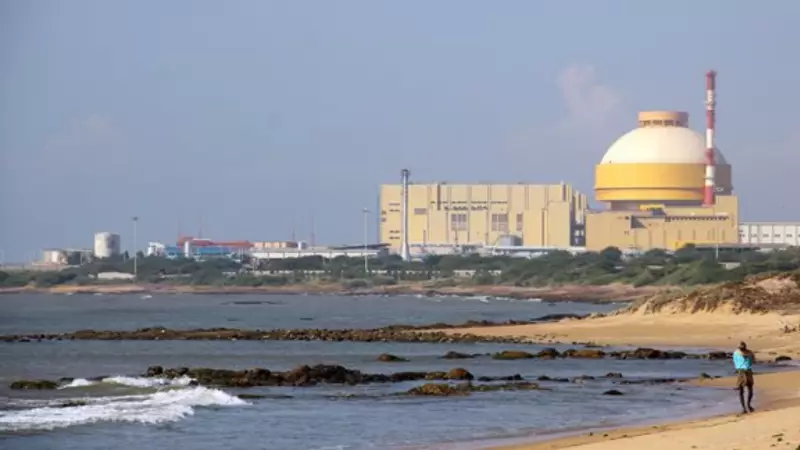
In a historic move, the Indian Parliament on Thursday passed the Sustainable Harnessing and Advancement of Nuclear Energy for Transforming India (SHANTI) Bill, 2025. This landmark legislation opens the nation's tightly controlled civil nuclear sector to private and foreign investment for the very first time since Independence, marking a paradigm shift in the country's energy policy.
A Transformational Moment for India's Energy Future
The Rajya Sabha approved the bill by voice vote, following its passage in the Lok Sabha a day earlier. The move defeated opposition demands to refer the bill to a parliamentary standing committee. Once it receives the President's assent, the SHANTI Bill will become law.
Prime Minister Narendra Modi hailed the development as a "transformational moment for our technology landscape." In a post on social media platform X, he linked the bill to India's clean energy ambitions and its global leadership in artificial intelligence and green manufacturing. He expressed gratitude to the MPs who supported its passage, stating it delivers a "decisive boost to a clean-energy future for the country and the world." The Prime Minister emphasized that the bill opens numerous opportunities for the private sector and youth, declaring, "This is the ideal time to invest, innovate and build in India!"

What the SHANTI Bill Actually Does: A Complete Overhaul
The bill's significance extends far beyond merely inviting private capital. It represents a comprehensive overhaul of India's nuclear governance architecture, consolidating safety, licensing, regulation, liability, and dispute resolution into a single, modern statute.
The key changes introduced by the SHANTI Bill are:
- Private Sector Entry: Indian private companies are now permitted to construct, own, and operate civil nuclear power plants. Foreign entities can participate through partnerships or joint ventures.
- Repeal of Old Laws: The Atomic Energy Act of 1962 and the Civil Liability for Nuclear Damage (CLND) Act of 2010 are being repealed, replaced by this unified regulatory framework.
- Redefined Liability Framework: The liability for operators is capped (for example, at Rs 3,000 crore for large reactors). The government can establish a Nuclear Liability Fund to cover claims exceeding this cap. Suppliers are generally protected from liability unless explicitly stated in their contracts.
- Empowered Regulator: The Atomic Energy Regulatory Board (AERB) is granted statutory status and legal independence as a safety watchdog, with powers to inspect, halt, or shut down operations.
- Dual Authorization: Nuclear plants will require both an operating license and a separate safety authorization. Every single activity, from construction to waste management, will need official approval.
Minister of State for Atomic Energy, Jitendra Singh, defended the bill in Parliament, asserting that India's safety protocols remain firmly grounded in the Nehru-era principle of 'safety first, then production.' He highlighted that nuclear energy would provide a reliable, steady 24x7 power source, unlike intermittent solar or wind energy, crucial for meeting exploding power demand from industries, data centers, and urban expansion.
Geopolitical Reset and Unlocking Stalled Projects
The bill carries profound geopolitical implications. India's 2010 liability law, particularly its controversial Section 17(b) which allowed victims to sue suppliers, had scared off global nuclear giants like GE, Westinghouse, and EDF, stalling projects worth billions. The SHANTI Bill removes this statutory risk, aligning India with global conventions like the Convention on Supplementary Compensation (CSC).
This move signals to capitals like Washington, Paris, and Tokyo that India is seriously open for business in the nuclear sector. It is expected to revive long-stalled projects, such as the Westinghouse project in Andhra Pradesh, and re-engage agreements with companies like EDF and Rosatom.

Opposition Concerns and the Road Ahead
Despite the government's push, the bill faced sharp criticism from opposition MPs in the Rajya Sabha. Concerns were raised about allowing private players into a strategic sector, with warnings about compromising sovereignty and socializing risks while privatizing profits.
RJD's Manoj Kumar Jha and IUML's Haris Beeran criticized the dilution of the liability framework, with Beeran stating it "dismantles the liability framework established after the Bhopal gas tragedy." Trinamool Congress MP Sagarika Ghose called the bill "fundamentally dangerous," questioning the preparedness to abdicate sovereign responsibility. DMK's P Wilson demanded the bill be sent to a Select Committee, labeling it a "nuclear bomb which threatens the country's peace and security."
Critics, including anti-nuclear activist G Sundarrajan, argue the bill weakens accountability, caps compensation for victims, and provides limited legal recourse. However, Union Minister Jitendra Singh countered, stating the bill was framed after "wide consultations" with experts and industry over more than a year, with safety and global benchmarks in mind.
The Big Picture: India Bets Big on Nuclear for a Clean Future
The SHANTI Bill is central to India's ambitious energy and climate goals. It aims to supercharge the clean energy transition, enabling a scale-up from the current 8.9 GW of nuclear capacity to a staggering 100 GW by 2047. This expansion is estimated to require investments worth Rs 19.3 trillion (approximately $214 billion).
This push aligns with a global rediscovery of nuclear power as a climate-friendly baseload source. Nations like China, South Korea, and Japan are expanding their fleets, while the US and EU are exploring Small Modular Reactors (SMRs). The SHANTI Bill strategically enables the SMR era in India, allowing private ownership and licensing for these compact reactors that can power industrial hubs, data centers, or green hydrogen plants.
The legislation also positions India as a climate-conscious global leader. It supports the nation's triad of goals: energy independence by 2047, 100 GW nuclear capacity by 2047, and net-zero emissions by 2070. The Department of Atomic Energy's budget, which has nearly tripled from Rs 13,879 crore in 2014 to Rs 37,483 crore in 2025, underscores this commitment.
Looking ahead, key questions remain on the speed of licensing, specific safety mandates, the operationalization of the liability fund, the true autonomy of the AERB, and managing potential local opposition akin to the Kudankulam protests. The world will now watch as India embarks on this new, transformative chapter in its energy journey.





