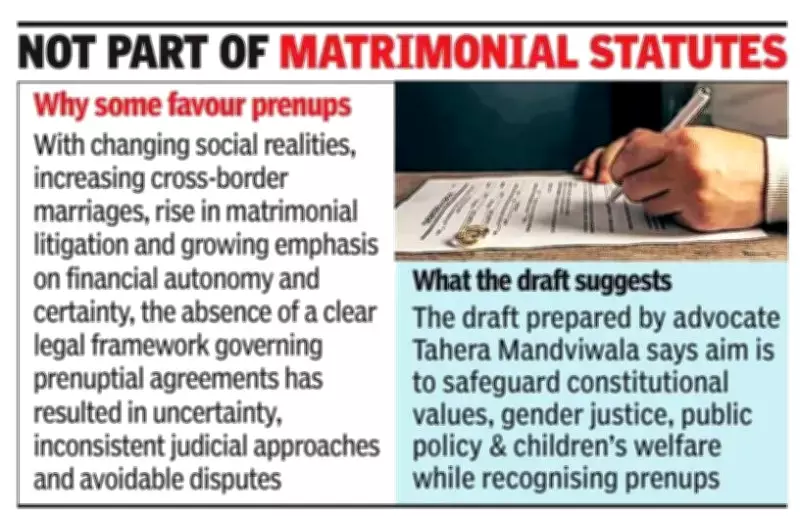
Mumbai: The billboard-topping singer Taylor Swift may perhaps say “shake it off” to those speculating whether she has signed a prenup ahead of her July wedding. But the buzz has drawn attention to the “blank space” Indian law has on prenuptial agreements. As divorce rates climb, the concept of prenups appears relevant to some and rash to others. Prenups are neither recognised nor enforceable under Indian law, but the legal panel of Indian Merchants’ Chamber (IMC) Ladies’ Wing has prepared a draft and planned a debate around it with retired Supreme Court Justice Jasti Chelemeswar and former Union minister Smriti Irani on Tuesday in Mumbai.
Western Concept Meets Indian Reality
Viewed as a Western concept, lawyers and women’s activists argue that the Unified Civil Code under the Constitution provides a window for its entry. Many believe the time has come to ensure couples have a way to outline financial responsibilities, even child maintenance arrangements, before tying the knot and not tie themselves up in knots over assets distribution when a rift happens.
Voices in Favor
Delhi-based senior advocate Meenakshi Arora, Mumbai’s Mrunalini Deshmukh, and IMC Ladies’ Wing president Rajyalakshmi Rao say prenups would primarily cut down long-drawn divorce battle timelines. “It will, if made legal, cut down a lot of litigation, too,” says Deshmukh.

Opposing Views
Divorce lawyer Mridula Kadam from Mumbai, however, feels that India “is not ready for it.” Signing such often confidential deals would “only benefit the uber rich or the urban lot,” she reasons. “The majority live in rural areas. Legalising prenups could lead to parents making deals detrimental to their daughters.”
A senior lawyer who is against prenups says such deals are meant to be voluntary even abroad, with full and proper disclosure of assets being absolutely essential, an uphill task in the best of times here.
Individual Autonomy vs. Holy Alliance
Should prenups state the case for “individual autonomy” when views on marriages as ‘a holy alliance’ change for the youth, ask many activists. India’s first woman additional solicitor general Indira Jaisingh says, “Prenups are the way forward to avoid multiple post-divorce disputes. It’s a demystification of marriage, not an end of all disputes relating to divorce.”
Jaisingh added, “I would like prenups to include all gifts given by the bride’s family if any at the time of engagement and marriage. This agreement must be subject to full prior disclosure by both parties and also subject to the oversight of the court to undo unfair or inequitable agreements.”
Real-World Examples
Arora adds, “It will help when it all becomes an unholy mess when a marriage breaks up. The Karisma Kapoor vs Priya Kapur mess (the legal battle over late businessman Sunjay Kapur’s Rs 30,000-crore estate) is a classic example and not just for succession planning.”
She says there have been a lot of cases of marriages lasting a few months to less than a year. Eventually, after mandated months of separation and much negotiation, such warring couples go the mutual consent way, but it costs time and money.
Benefits for Women
Arora says prenups may also help women get out of violent marriages when they know what they are getting. While she says no one comes and asks for prenups to be drawn up because they know it has no legal sanctity, in Mumbai, both Kadam and Deshmukh say the wealthy, high net-worth individuals or those wary of any future divorce playbook who seek fencing of assets seek a draft to ensure there are no surprises in unilateral proceedings. “The demand has risen in the last five years,” says Deshmukh. The request, she says, is even from the divorced looking to walk down the aisle a second time.
Middle Ground Sought
Kranti Sathe, a veteran family court lawyer, favours the middle ground. Any move to make prenups, which she dubs a “very elitist concept”, valid in India, needs to be backed with multiple checks to ensure that no party is left at a disadvantage, she says.
Stay updated with the latest Mumbai news. Download the TOI App.

About the Author: Swati Deshpande is Senior editor at The Times of India, Mumbai, where she has been covering courts for over a decade. She is passionate about law and works towards enlightening people about their statutory, legal and fundamental rights. She makes it her job to decipher for the public the truth, be it in an intricate civil dispute or in a gruesome criminal case.