

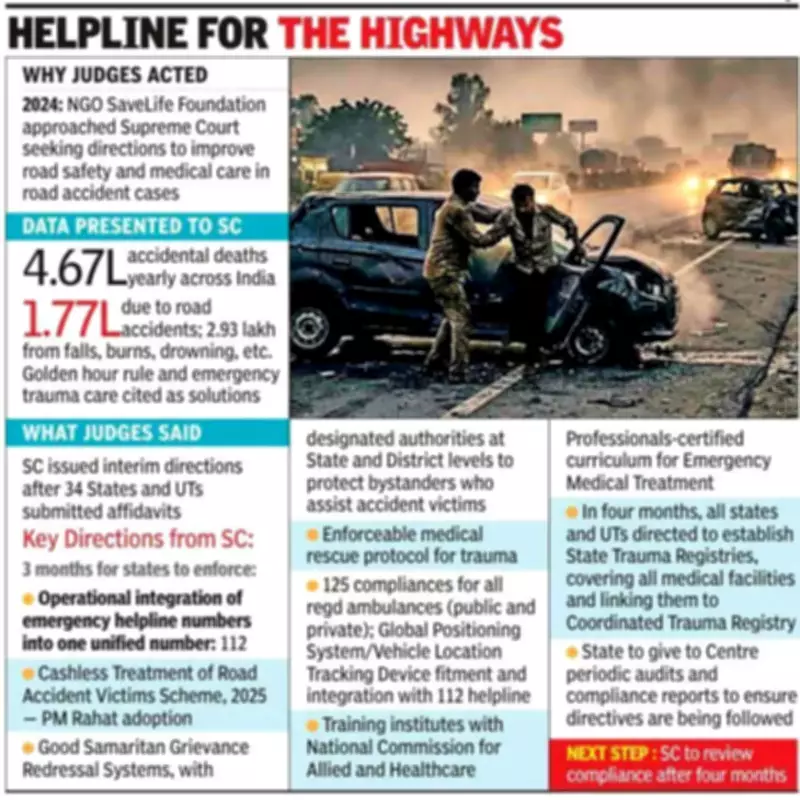
The Supreme Court has called for a 'bottom-up approach' to establish a robust trauma care mechanism, involving all stakeholders including Good Samaritans, to save lives in road accidents. To enhance efficiency, the apex court directed the unification of all emergency helplines across the country under a single number 112.
Right to Trauma Care
A bench of Justices J K Maheshwari and Atul Chandurkar, in a ruling on May 26, asserted that the right to trauma care is an integral part of the right to life under Article 21 of the Constitution. The order came on a petition filed by the NGO Savelife Foundation in 2024, seeking court intervention to revamp emergency trauma care, address systemic gaps, and establish grievance redressal systems to protect Good Samaritans who assist accident victims.
Systemic Gaps and Legal Protections
The petition cited studies indicating that prompt care prevents deaths, while delays contribute to at least 30% of fatalities. A decade ago, in an earlier petition by the same NGO, the Supreme Court recognized the need for Good Samaritan laws, leading to amendments in the Motor Vehicles Act in 2019. The NGO now sought orders to bridge systemic gaps, including legal protection for those assisting accident victims, a rescue protocol for trauma care, and a certified curriculum to train paramedics providing emergency treatment.

The Supreme Court directed all states to establish functional Good Samaritan Grievance Redressal Systems, both physical and digital, with periodic compliance reports. The court emphasized that a common bystander has a responsibility to call emergency services, provide accurate descriptions, attempt to control bleeding, and keep victims still, calm, and warm. However, it noted that bystanders often hesitate due to fear of legal proceedings or being summoned as witnesses, leading to reactive paralysis.
Unified Helpline and Trauma Registry
The court directed the integration of all emergency and ambulance helplines (100, 101, 108, 102, 1033, 1091, etc.) into helpline 112 within three months, with wide publicity. The Centre was also directed to issue guidelines for a Trauma Registry within eight weeks, and all states and union territories must establish State Trauma Registries conforming to these guidelines, covering all medical facilities and linking them to a Coordinated Trauma Registry within four months.
The Supreme Court considered submissions from Attorney General P Venkatramani for the Centre and senior counsel Siddharth Luthra for the NGO, along with responses from 34 states and union territories. The court observed that vital steps include quick response in the form of transportation equipped with trained paramedics and healthcare facilities well equipped to deal with urgent care.
Compliance and Implementation
The court requested compliance reports and asked the Attorney General to suggest a way for efficient and effective implementation of trauma care to further this cause earnestly.






