

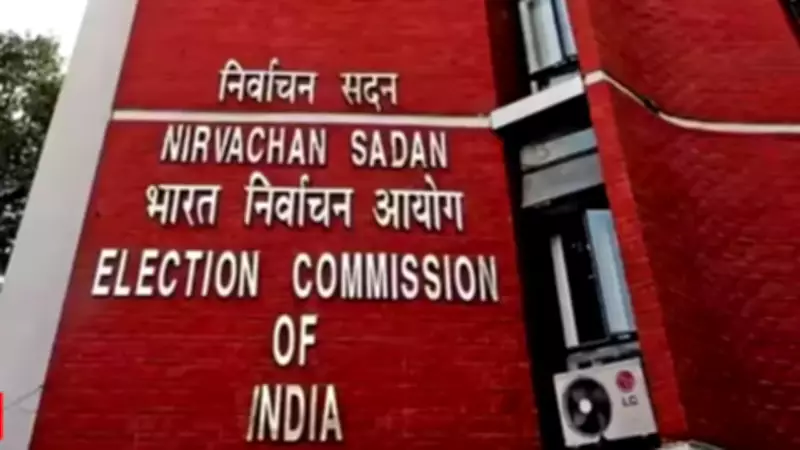
The Supreme Court on Thursday scrutinized the appointment of Gyanesh Kumar and S S Sandhu as election commissioners in 2023, noting that the government showed remarkable speed in the process. The court expressed a wish that similar urgency be applied to the appointment of judges, especially in high courts.
Background of the Appointments
Kumar and Sandhu were appointed under the new CEC and Other Election Commissioners (Appointment, Conditions of Service and Term of Office) Act, 2023, which established a selection committee comprising the Prime Minister, a Union Cabinet minister, and the Leader of the Opposition (LoP). The validity of this law is currently under review by the Supreme Court.
Petitioners' Arguments
Senior advocate Vijay Hansaria, representing petitioner Jaya Thakur, argued that the appointments were made without effective consultation. He highlighted that names were not shortlisted until March 13, 2023, and the LoP was presented with a list of 200 names. The selection committee met the next day and selected Kumar and Sandhu from six names. Hansaria questioned how the LoP could be expected to review so many names in a single day, calling it a consequence of giving absolute power to one individual.

Senior advocates Sanjay Parikh, Shadan Farasat, and Prashant Bhushan, representing other petitioners, contended that the law was passed without proper parliamentary discussion, as 141 opposition MPs were suspended at the time. They argued that the legislation was designed to overturn a 2023 Supreme Court verdict that required the Chief Justice of India (CJI) to be part of the selection panel. Under the new law, the CJI was replaced by a Union Cabinet minister.
Court's Observations
Responding to Hansaria's submission, the bench of Justices Dipankar Datta and Satish Chandra Sharma stated, 'We can only say that we wish such speed is shown in the appointment of judges. Especially HC judges.' However, the court declined to accept Hansaria's allegation that the appointments were made just before a scheduled hearing on March 15 to frustrate court proceedings, citing lack of evidence.
Justice Datta, referencing a former parliamentarian's term 'tyranny of the unelected' used for judicial activism, remarked, 'I am reminded of a parliamentarian saying tyranny of the unelected. This should be equated with tyranny of the elected.' He added that whoever comes to office engages in similar behavior, which is unfortunate for the country. The bench recalled a BBC video on Dr. Ambedkar, who had said within three years of framing the Constitution that democracy was not working in the country.
Broader Implications
The petitioners emphasized that the independence of the Election Commission is as crucial as that of the judiciary. They argued that the executive should not have a dominant say in poll panel appointments, as it could lead to the selection of a 'yes man,' severely affecting the commission's impartiality, which is the bedrock of the republic and democracy.
Bhushan submitted that every political party in office has attempted to use the commission for political gains. He noted that while parties in opposition demand a free poll panel, they refrain from decisive action when in power. The law was framed only after the Supreme Court intervened in 2023, he said.






