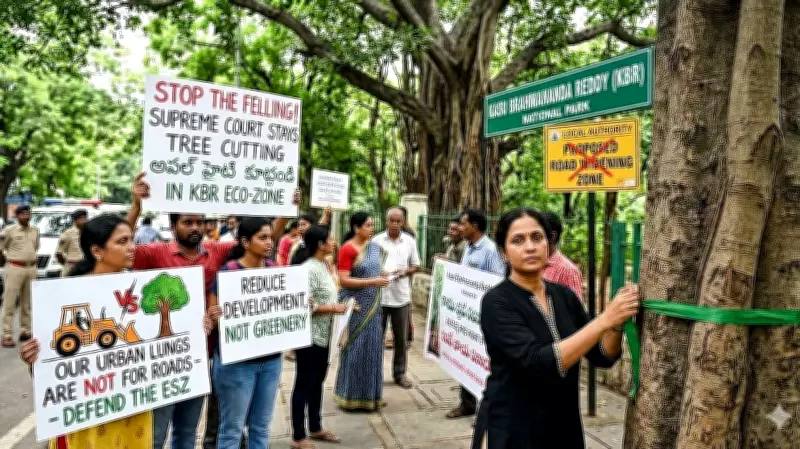
The Supreme Court on Tuesday stayed the felling of trees in the eco-sensitive zone of Hyderabad’s KBR National Park, a move that has brought relief to environmental activists and residents. The bench, comprising Justices B.R. Gavai and K.V. Viswanathan, issued the interim order while hearing a petition challenging the Ministry of Environment, Forest and Climate Change’s notification of October 27, 2020, which had fixed a narrow eco-sensitive zone (ESZ) around the park.
Background of the Case
The Ministry’s notification had sparked controversy for allegedly reducing the buffer zone around the national park, allowing developmental activities that threatened the fragile ecosystem. The Telangana High Court had earlier upheld the notification, prompting the petitioners to approach the Supreme Court. The petitioners argued that the narrow ESZ would lead to unchecked urbanization, endangering wildlife and green cover in the region.
Supreme Court’s Intervention
During the hearing, the Supreme Court expressed serious concern over the potential environmental damage. “Tree felling cannot be allowed in an eco-sensitive zone without proper scrutiny,” the bench observed. The court directed the Ministry to file a detailed affidavit explaining the rationale behind the 2020 notification and its compliance with the Wild Life (Protection) Act, 1972, and the Environment Protection Act, 1986. Until further orders, no tree felling or construction activities will be permitted in the ESZ.

Implications for Hyderabad’s Environment
KBR National Park, located in the heart of Hyderabad, is a vital green lung for the city. It houses diverse flora and fauna, including several endangered species. Environmentalists have long demanded a larger buffer zone to protect the park from encroachment. The Supreme Court’s stay is seen as a significant victory for conservation efforts, though the final outcome depends on the Ministry’s response.
The next hearing is scheduled for June 15, 2026. Until then, the status quo will be maintained, ensuring no further damage to the park’s ecosystem.