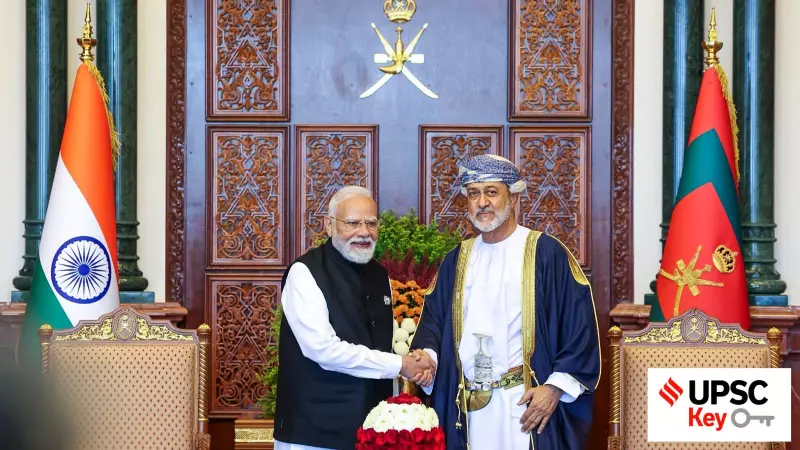
In a significant development for India's trade strategy, Prime Minister Narendra Modi and Oman's Sultan Haitham bin Tarik signed the Comprehensive Economic Partnership Agreement (CEPA) in Muscat on Thursday, December 19, 2025. This landmark free trade pact is India's second with a Gulf Cooperation Council (GCC) nation, following the UAE deal, and aims to bolster market access for Indian exporters in West Asia amid rising global trade barriers.
India-Oman CEPA: A Strategic Trade Corridor
The agreement promises substantial economic benefits. Oman has offered zero-duty access on 98% of its tariff lines, potentially boosting Indian exports by $2 billion. Key sectors set to gain include gems and jewellery, textiles, leather, footwear, and engineering goods. In return, India has liberalised tariffs on 77.79% of its lines, safeguarding sensitive areas like dairy, tea, coffee, and certain agricultural products.
Beyond goods, the CEPA enhances services trade, with Oman increasing the quota for Intra-Corporate Transferees from 20% to 50%. It also eases entry for skilled Indian professionals in sectors like accountancy, architecture, and medicine. With Oman's annual imports hovering around $40 billion, and Indian exports to the Sultanate doubling from $2 billion to $6 billion in five years, the deal is poised for significant impact.

Strategically, Oman serves as a vital gateway to the broader Gulf and African markets. Experts note this agreement strengthens India's West Asia strategy, providing a counterbalance to increasing trade restrictions from Western economies like the US and EU.
Allahabad HC Upholds Rights in Live-in Relationships
In a notable judicial pronouncement, the Allahabad High Court has affirmed that live-in relationships are not illegal. Hearing petitions from 12 women seeking protection, Justice Vivek Kumar Singh stated that while such relationships "may not be acceptable to all," they do not constitute an offence. The court emphasised the State's duty to protect every citizen, and that a couple's unmarried status does not strip them of fundamental rights under Article 21 of the Constitution.
This ruling contrasts with the Uttarakhand Uniform Civil Code's approach, which requires couples in live-in relationships to submit a detailed form and obtain eligibility certificates. The court's decision reinforces the judiciary's role in protecting individual autonomy and personal choices, a topic frequently debated in the context of Indian society's evolving fabric.
Parliament Passes GRAM G Bill, Replacing MGNREGA
Amidst protests, the Lok Sabha passed the Viksit Bharat-Guarantee for Rozgar and Ajeevika Mission (Gramin) Bill, 2025, commonly called the GRAM G Bill, which effectively repeals the Mahatma Gandhi National Rural Employment Guarantee Act (MGNREGA). The Bill was passed by voice vote.
The new legislation increases guaranteed employment days from 100 to 125 per household annually. However, it introduces a major shift in funding: the Centre will now fund 60% of all costs, with states bearing 40%. Under MGNREGA, the Centre covered all wage costs and 75% of material costs. Critics argue that this new cost-sharing model, coupled with a centralised, normative allocation system, could strain state finances and dilute the demand-driven nature of the original scheme, which was hailed as a social safety net, especially during the COVID-19 pandemic.
India-Russia Logistics Pact: Eye on Arctic & Indo-Pacific
Deepening defence ties, India and Russia have solidified the Reciprocal Exchange of Logistics Support (RELOS) agreement, recently signed into law by President Vladimir Putin. This pact provides a framework for mutual use of naval bases, airfields, and ports for refuelling, repairs, and maintenance during exercises, training, and disaster relief operations.
For India, RELOS grants strategic access to Russian facilities from Vladivostok in the Pacific to Murmansk in the Arctic, enhancing operational reach for the Indian Navy and Air Force, particularly for Russian-origin equipment. This supports New Delhi's Indo-Pacific strategy. In return, Russia gains greater access to Indian ports and airfields. The agreement is tailored to the India-Russia partnership, distinct from similar logistics pacts India has with the United States.

Editorial Focus: Delhi's Air Needs a Custom Plan
An editorial analysis underscores that Delhi's air pollution crisis requires solutions beyond generic national templates. Data shows that even the 2020 COVID-19 lockdown could not fully clear the city's air, with 49 'very poor' and 15 'severe' air quality days recorded that year. The piece argues that Delhi's geography in the Gangetic plains traps pollution, making meteorology a dominant factor.
The critique calls for a shift from reactive measures under the Graded Response Action Plan (GRAP) to a predictive, preventive, and airshed-wide approach. It advocates for using AI and satellite data for pre-emptive action, complete dust-proofing of construction sites and roads, stable electricity to phase out diesel generators, and mass public participation to build a sustainable clean air strategy.
These developments collectively cover crucial areas of international relations, Indian society, governance, and environment—all central themes for the UPSC Civil Services Examination, both in Preliminary and Mains stages.