Two decades after India positioned itself as a global guide by enacting the National Rural Employment Guarantee Act (NREGA), a new legislative proposal threatens to undo its foundational principles. Economist Jean Drèze, in a recent critique, contends that the VB-G RAM G Bill 2025 does not reform but rather sinks the landmark scheme by demotivating state governments and disempowering rural workers.
From Vishwaguru to a Pale Shadow
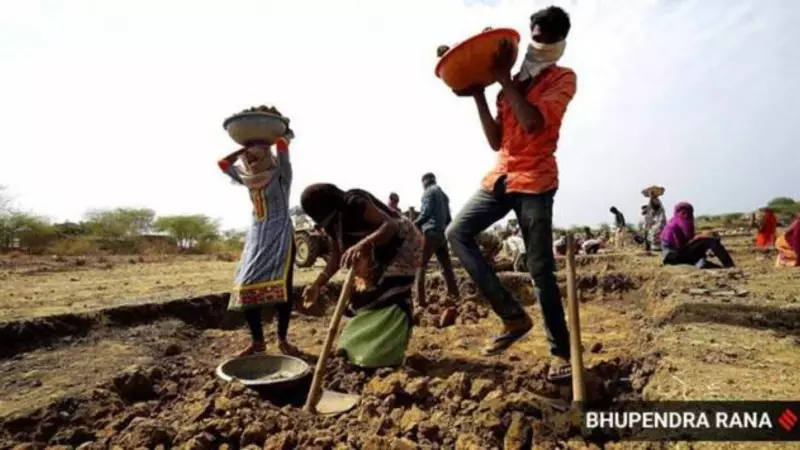
The Mahatma Gandhi National Rural Employment Guarantee Act (MGNREGA), launched in 2005, was a pioneering national initiative with unanimous parliamentary support. By 2011-12, it was a demonstrable success, generating over 200 crore person-days of work annually for about 50 million households. Nearly half the beneficiaries were women, and over 40% belonged to Scheduled Castes or Scheduled Tribes. This period saw rural wages rising at an unprecedented rate, with studies indicating positive effects on overall economic output.
However, Drèze notes that implementation hurdles like centralisation, technocracy, chronic underfunding, and delayed wage payments later eroded the scheme's effectiveness. While a revival was seen during the Covid-19 crisis, MGNREGA today remains a weakened version of its original vision. The solution, he argues, lies in renewed political commitment to fix these operational issues, not in dismantling the Act's core framework.

The Core Flaws of the VB-G RAM G Bill
The proposed Bill seeks to replace the Act with a centrally-directed scheme. Drèze highlights several critical reversals:
Shift of Obligation to States: The Centre retains full powers but palms off all key obligations to state governments. These include providing employment, paying unemployment allowances, compensating for delayed wages, and ensuring adequate funding. The Centre's discretionary power includes a "switch-off clause" to decide where and when the scheme is implemented, effectively nullifying the guarantee of work.
New Financial Architecture: The Bill moves away from the principle of open-ended central funding. Instead, the Centre will set state-wise normative allocations. Within these limits, costs will be shared 60/40 between the Centre and states. Any expenditure beyond the central allocation must be borne entirely by the states. Previously, states only bore 25% of material costs, creating a strong incentive for implementation. This new pattern, Drèze warns, acts as a "huge spanner in the wheel."
The risk of political misuse of these discretionary powers is not theoretical. Drèze points to the discontinuation of MGNREGA funding to West Bengal over the last three years, a move never clearly explained in Parliament, as a precursor.
Demotivating States and Undermining Projects
The funding change critically impacts project-driven demand. Farmers and communities often activate MGNREGA to build wells, ponds, roads, and other assets, with the Centre bearing most costs. Under the new scheme, states must fund 40% to 100% of new projects, likely causing poorer states to slow or stop project sanctions. Furthermore, the Bill imposes legally-binding financial obligations on states without guaranteeing adequate central funds or prior consultation.
Distractions and Cosmetic Changes
Drèze identifies two "red herrings" distracting from the Bill's destructive nature. The first is the proposed renaming to Viksit Bharat G RAM G Act, which he calls a waste of time and money that detracts from the scheme's non-partisan character.
The second is the enhanced employment ceiling from 100 to 125 days per household per year. While welcome, Drèze argues this is largely cosmetic. Only about 2% of rural households currently get the full 100 days, making the raised ceiling irrelevant for most. When financial restrictions tighten, raising the limit offers little real benefit. A more effective measure would be to increase wage rates, particularly in poorer states.
In conclusion, Jean Drèze asserts that the VB-G RAM G Bill 2025, far from revamping India's employment guarantee, systematically dismantles it by stripping away its guarantee mechanism and burdening states. He calls it the potential end of an era, unless public pressure leads to its repeal, much like the Farm Laws.