

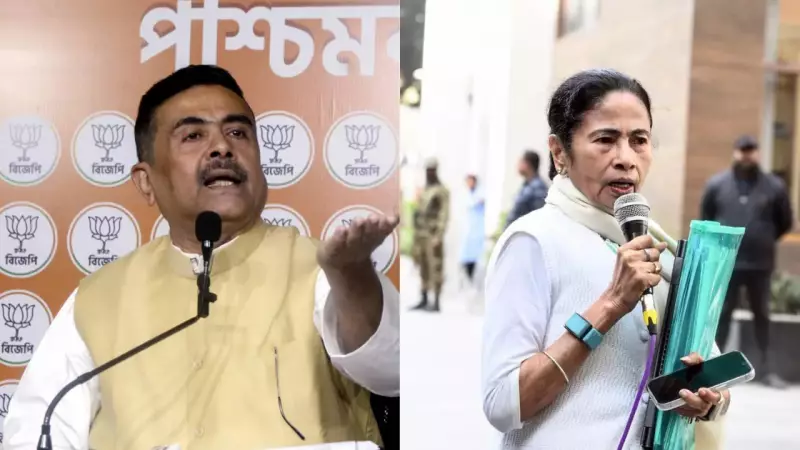
In a sharp escalation of political tensions in West Bengal, Leader of the Opposition Suvendu Adhikari on Sunday launched a fierce counterattack against Chief Minister Mamata Banerjee, dismissing her severe criticism of the ongoing Special Intensive Revision (SIR) of electoral rolls as a "desperate and politically motivated" act.
A Letter of Rebuttal to the Election Commission
Adhikari, in a detailed letter addressed to Chief Election Commissioner Gyanesh Kumar, strongly defended the Election Commission of India's (ECI) exercise. He asserted that Banerjee's allegations were an unfounded attempt to sabotage a process that has exposed critical vulnerabilities in the state's voter lists, which he claimed directly threatens the prospects of her Trinamool Congress (TMC) party.
The BJP leader categorically rejected the Chief Minister's characterization of the SIR as "unplanned, insensitive, and inhuman," labeling these claims as exaggerated and driven purely by political motives.

Disputing Allegations of Harassment and Deaths
Adhikari addressed the most serious charges head-on. He stated that allegations of public harassment, intimidation, and excessive workload due to the revision are completely unsubstantiated. He specifically challenged Banerjee's attribution of 77 deaths, four suicide attempts, and 17 hospitalizations to the SIR process.
He accused the CM of fabricating these figures or opportunistically linking unrelated tragic incidents to the electoral exercise. "There is no verifiable evidence connecting these tragic events to the electoral revision," Adhikari wrote. He further argued that this reflects a pattern of blaming central institutions to cover up failures in local governance.
Defending the EC's Impartial Process
The Leader of the Opposition staunchly defended the ECI's conduct, emphasizing that the SIR is a verification process, not a punitive one. He highlighted that any genuine issues faced by citizens could be resolved through the established appeals mechanism. Sensationalizing such matters for political gain, he contended, undermines real human tragedies and disrespects affected families.
Adhikari also countered claims of selective targeting or "logical discrepancies" in specific constituencies, maintaining that the revision is a uniform, data-driven process applied across the entire state. He dismissed concerns over women's surname changes post-marriage and the treatment of migrant workers as being overstated.
The Core Political Allegation
In his most pointed accusation, Adhikari suggested that the SIR has inflicted "irreparable damage" to the TMC by uncovering a "rot" in the voter rolls. He alleged this rot was cultivated over years through the unchecked addition of bogus voters, including infiltrators from across borders.
He concluded that halting or diluting this crucial exercise would be a betrayal of democratic ideals and would disenfranchise genuine voters who deserve clean and transparent elections. This clash sets the stage for a heated political battle in Bengal as the Election Commission continues its revision work.






