Ahmedabad's Parking Crisis: A Legacy of Legalized Encroachments
For over two decades, Ahmedabad has grappled with a self-inflicted urban dilemma that it has systematically legalized. Through three successive implementations of the Gujarat Regularization of Unauthorized Development Act (GRUDA), most recently in 2022, the city has effectively sanctioned illegal constructions in exchange for impact fees. This policy has created a profound and lasting impact on the city's infrastructure, particularly its parking availability.
Erosion of Formal Parking Spaces
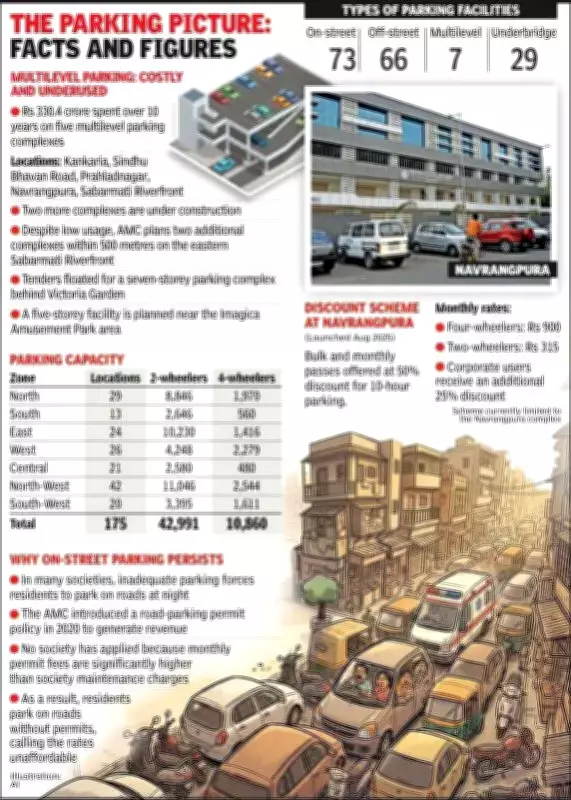
Among the most problematic outcomes of GRUDA has been the regularization of parking spaces in housing societies and commercial complexes that had already been built over or encroached upon. This practice has led to a significant erosion of formal parking spaces across Ahmedabad, directly contributing to worsening congestion on already overburdened roads. For candidates elected to the Ahmedabad Municipal Corporation (AMC) in the upcoming 2026 civic election, resolving this parking crisis will represent one of the toughest governance challenges.
Infrastructure Investments Yield Limited Returns
Despite substantial investments in urban infrastructure, the returns have been disappointingly limited. Over the past five years, several multilevel parking complexes have been constructed throughout the city, but most have failed to attract sufficient users. A comprehensive parking development plan, promised for years by municipal authorities, remains conspicuously absent. Although a draft parking policy exists, there is no citywide, long-term roadmap to translate its provisions into concrete action.

Current AMC Initiatives and Challenges
AMC officials acknowledge that traffic congestion has worsened significantly due to haphazard, on-street parking that often blocks emergency vehicle movement. An agency appointed by the corporation is currently preparing a parking plan, beginning with the western parts of the city. This initiative involves:
- Road surveys to assess parking needs and challenges
- Identification of on-street parking zones
- Marking of no-parking areas
So far, parking has been prohibited within a 50-meter radius of more than 250 junctions in the city's western zones, with signage installed and enforcement mechanisms planned. Surveys to identify both on-street and off-street parking spaces are underway, but similar work in the eastern zones has not yet commenced.
Implementation Hurdles and Policy Delays
The designation of on-street parking on newly constructed western roads has been temporarily suspended, while parking fees—crucial for demand management—remain undecided. An AMC official, speaking anonymously, revealed that the state government approved the parking policy in October 2021. This policy proposed creating a dedicated parking cell comprising AMC officials, traffic police, Regional Transport Office representatives, and urban planning experts.
"The cell was meant to enforce parking bylaws, but a 10-year parking plan was a prerequisite," the official explained. While consultants were appointed for the western zones, the parking cell has still not been formally established, and planning for the eastern part of the city remains untouched.
Growing Impact on Public Safety
The congestion problem now extends beyond inconvenience for daily commuters. During peak hours, emergency vehicles including ambulances face significant delays navigating through traffic-clogged streets. In response to these mounting challenges, the AMC issued a public notice on April 5 requiring all commercial complexes to ensure vehicles are parked only in designated spaces.
New Regulatory Measures
The municipal corporation has implemented several new requirements:

- Residential and commercial buildings must file annual self-declarations confirming that parking areas remain free of encroachments
- Societies with surplus parking capacity may apply for parking sharing arrangements
- Responsibility for parking violations rests with building chairpersons or secretaries
These measures represent initial steps toward addressing a crisis that has developed over decades, but their effectiveness will depend on consistent enforcement and broader systemic changes to Ahmedabad's urban planning approach.