

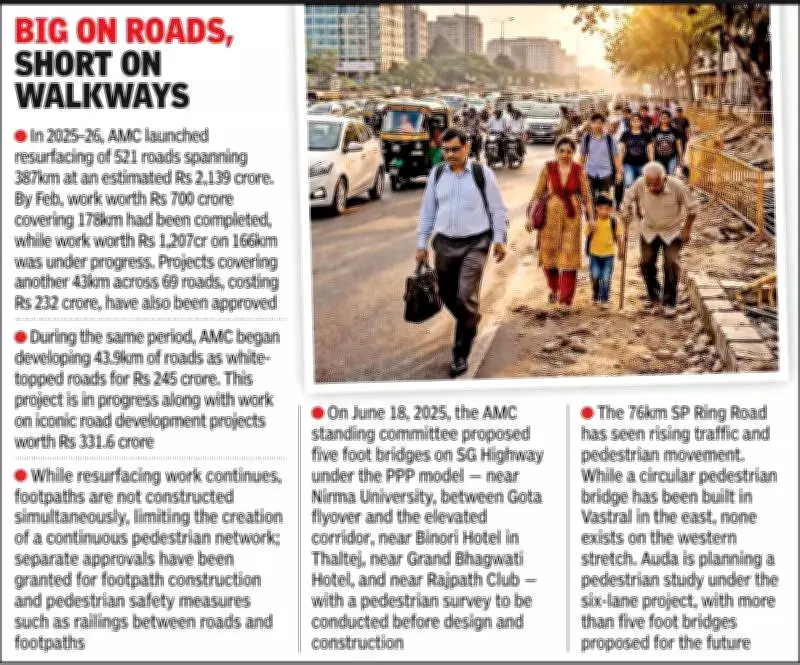
Ahmedabad's Pedestrian Crisis: 72% of Roads Lack Footpaths Ahead of 2026 Elections
As Ahmedabad prepares for the crucial 2026 municipal elections, a critical urban infrastructure deficiency has emerged as a central concern. The city remains overwhelmingly hostile to pedestrians, with a staggering 72% of its roads completely lacking footpaths. This alarming statistic highlights a significant gap in urban planning that affects millions of residents who navigate traffic-heavy streets daily.
The Stark Reality of Ahmedabad's Road Network
According to official data from the Ahmedabad Municipal Corporation's 2023–24 budget, only 28% of the city's extensive 2,634-kilometer road network currently features designated pedestrian pathways. This translates to a mere 731.43 kilometers of roads with proper footpaths, leaving the vast majority of citizens vulnerable while walking alongside vehicular traffic.
The situation is particularly dire in newly developed and recently merged areas including Jodhpur, Vejalpur, Bodakdev, Thaltej, Gota, Vastral, Chandkheda, Motera, Bopal, Ghuma, and Kathwada. These neighborhoods, which have seen substantial growth over the past decade, often feature roads constructed without any accompanying pedestrian infrastructure whatsoever.

Systemic Failures in Infrastructure Development
Civic officials acknowledge that while resurfacing and widening projects have continued at a steady pace, footpath construction has consistently lagged behind. This disparity has resulted in fragmented pedestrian networks that fail to provide safe, continuous walking routes across the city.
"The corporation spends crores every year on roads, but without building footpaths alongside, a proper pedestrian network never takes shape," revealed a senior AMC official who requested anonymity. This admission underscores a fundamental flaw in the city's approach to urban development.
The problem has been exacerbated by repeated failures in the tender process. Since 2023, multiple attempts to award contracts for footpath construction—including a substantial Rs 50 crore citywide tender—have collapsed due to insufficient bidders or disqualification of applicants. Even after dividing tenders into smaller, zone-wise packages of Rs 10 crore each, contractor response remained disappointingly lukewarm.
It was only on the fourth attempt that limited participation materialized, with a few contracts finally proceeding at marginally reduced costs. This procurement struggle has significantly delayed critical pedestrian infrastructure projects throughout Ahmedabad.
Municipal Corporation's Response and Future Plans
Facing mounting criticism from citizens and urban planners alike, the Ahmedabad Municipal Corporation has announced a renewed infrastructure push under its 2026–27 policy framework. The ambitious plan aims to develop 200 kilometers of pedestrian-friendly roads at an estimated cost of Rs 50 crore.
Additional safety measures include installing protective railings between roads and footpaths to prevent accidents and enhance pedestrian security. These initiatives represent a recognition of the growing demand for walkable urban spaces.
Parallel to these efforts, larger urban design projects are being implemented across the city. The civic body has allocated Rs 400 crore specifically to transform key arterial routes—including the prominent Ashram Road—into 'iconic roads' featuring integrated footpath systems.
Furthermore, Rs 334 crore has been sanctioned for precinct-level development projects that incorporate pedestrian infrastructure as a core component. Footpath construction is also being systematically integrated into ongoing white-topping road projects, signaling a potential shift in approach.
Urban Planners Sound Warning Bells
Despite these announcements, urban planning experts caution that Ahmedabad risks perpetuating its car-centric development model unless fundamental changes occur. They emphasize that footpath construction must become a mandatory, non-negotiable component of every road project rather than an optional afterthought.

The continued prioritization of vehicular traffic over pedestrian safety threatens to undermine the city's livability and accessibility for all residents. As Ahmedabad grows and evolves, the absence of comprehensive pedestrian infrastructure represents not just an inconvenience but a significant public safety concern that demands immediate, sustained attention from municipal authorities.
With municipal elections approaching in 2026, pedestrian infrastructure has emerged as a critical issue that could influence voter sentiment and shape the city's development trajectory for years to come. The coming months will reveal whether announced initiatives translate into tangible improvements on Ahmedabad's streets.





