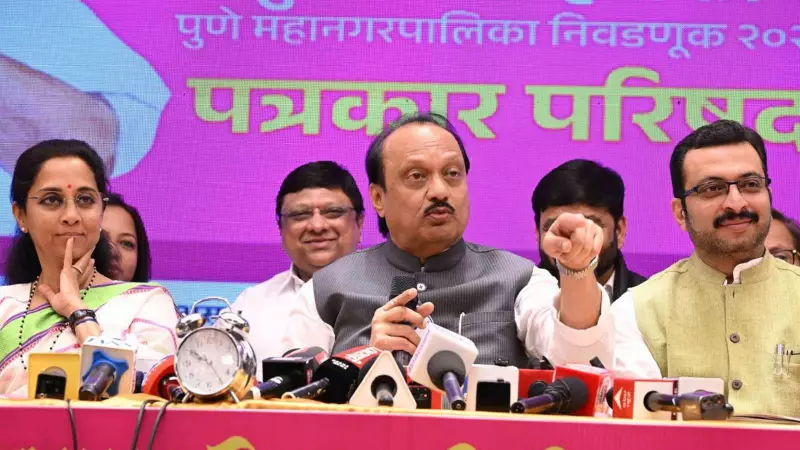
Maharashtra Deputy Chief Minister and NCP chief Ajit Pawar has unveiled a bold proposal for a free public transport system in Pune, citing staggering economic losses of Rs 900 crore every month due to the city's crippling traffic congestion. The announcement was made during the joint unveiling of the NCP and NCP(SP) manifesto for the upcoming Pune Municipal Corporation (PMC) elections on January 15.
The Staggering Cost of Pune's Gridlock
Ajit Pawar provided a detailed breakdown of the massive financial burden imposed on Pune's citizens by daily traffic jams. He stated that with 30 lakh private vehicles in the city, approximately 15 lakh are on the roads each day. Pawar explained that the average citizen loses an hour daily in traffic, consuming about half a litre of fuel worth Rs 50 per vehicle.
"For 30 days, this fuel expense loss is Rs 7.5 crore per day," Pawar elaborated. He further calculated the productivity loss, valuing one man-hour at Rs 250 per person, which amounts to Rs 22.5 crore lost daily. Combining both, the daily loss totals Rs 30 crore, escalating to Rs 900 crore monthly and a colossal Rs 12,800 crore annually.

The Free Transport Blueprint and Funding
Pawar asserted that a free bus and metro service is not just a promise but a feasible plan developed with field experts. He revealed that after discussions with Pune Metro and Pune Mahanagar Parivahan Mahamandal Limited (PMPML), the scheme would require monthly payments of Rs 5 crore to Pune Metro and Rs 20 crore to PMPML.
"The total of Rs 25 crore per month and Rs 300 crore annually funded by the civic body for Metro and PMPML is affordable," Pawar argued. He justified this by comparing it to the civic budgets of Rs 12,600 crore for PMC and Rs 9,600 crore for Pimpri Chinchwad Municipal Corporation. He drew parallels to manageable state-level schemes like Ladki Bahin and free power for farmers.
Broader Benefits and Political Consensus
Beyond economic savings, Pawar highlighted significant ancillary benefits. A robust, free public transport system would discourage private vehicle use, leading to reduced traffic congestion and lower air pollution. It would also conserve natural resources and public money. He cited successful international examples in Luxembourg, Estonia, and several cities in the United States and France.
Echoing the urgency, NCP(SP) working president Supriya Sule identified traffic as the city's biggest concern. She emphasized the importance of last-mile connectivity to ensure maximum Metro rail usage and assured that the NCP and NCP(SP) would handle it efficiently. "The plan for an effective public transport system is ready," Sule stated, indicating a united front on the issue ahead of the civic polls.
The proposal sets the stage for a major policy shift in Pune's urban mobility, positioning free public transport as a critical solution to an economic and environmental crisis.