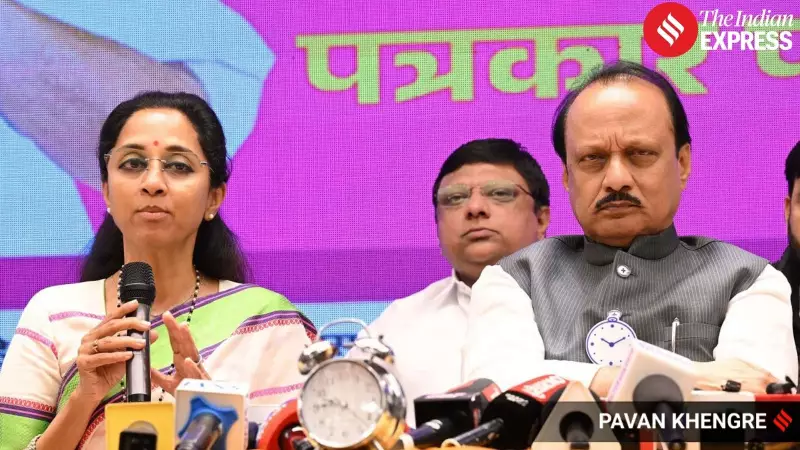
In a significant political move ahead of the Pimpri-Chinchwad Municipal Corporation (PCMC) elections, Deputy Chief Minister and NCP national president Ajit Pawar, alongside party MP Supriya Sule, released a joint manifesto on Saturday, January 10, 2026. The document, presented as a "Guarantee card" for citizens, outlines a series of ambitious promises aimed at addressing key civic issues in the industrial twin city.
Core Promises: Water, Transport, and Development Plan
Addressing a gathering in Pune, Ajit Pawar declared that the foremost priority of the alliance would be to ensure daily water supply to all areas of Pimpri-Chinchwad, replacing the current system of supply on alternate days. He criticized the incumbent administration, stating that citizens had suffered due to mismanagement over the past nine years, often having to wake up at odd hours to collect water.
"We will ensure that citizens get daily water supply," Pawar asserted. He linked the water crisis to the tanker mafia, promising that a reliable daily supply would end their dominance. A major focus will be on completing the long-stalled Pavana pipeline project, which has seen its cost balloon from an estimated Rs 380 crore to over Rs 1,100 crore. The plan involves taking residents of Maval into confidence and drawing water directly from the Pavana dam.
In a major populist announcement, Pawar promised to extend free Metro and PMPML bus services to Pimpri-Chinchwad, mirroring a similar pledge for Pune. He clarified that this was not merely an election sop but a policy aimed at boosting public transport, reducing traffic congestion, and cutting pollution. The municipal corporations would reimburse the transport authorities for the free rides.
Another contentious issue addressed was the Draft Development Plan (DP). Pawar announced that the controversial plan, which had attracted at least 50,000 objections from citizens, would be scrapped entirely. A new process would be initiated to formulate a more acceptable plan.
A Manifesto Built on Public Feedback
Pawar emphasized that the manifesto was the result of six months of ground-level surveys, ward-wise interactions, and public dialogues (Jansamvad). It encapsulates what he termed the "Seven Commitments, New Beginning" philosophy, targeting time-bound solutions to civic problems.
Beyond water and transport, the guarantees include:
- Road Infrastructure: Time-bound repairs, contractor accountability, and completion of pending flyovers and metro links.
- Waste Management: 100% waste segregation, scientific processing, and creating zero-landfill zones.
- Healthcare: Expansion of hospitals, 100 new neighbourhood clinics, and low-cost diagnostic facilities.
- Education: Upgrading municipal schools to national standards, providing free tablets to students, and offering interest-free loans for women.
The Deputy CM also pledged to find a resolution to the long-pending "Red Zone" issue by engaging with the Defence Ministry.
Political Counterpoints and Legacy
When questioned about Chief Minister Devendra Fadnavis's remark that he had not followed "alliance dharma," Ajit Pawar retorted that he was merely highlighting the failures of the BJP-led civic administration. "BJP had made 27 promises for PCMC citizens. However, they failed to keep even one promise," he claimed.
He contrasted the current state of the city with the 25-year rule of the NCP, claiming that era saw wider, pothole-free roads and less traffic. Pawar framed the manifesto's resolves as being inspired by the legacies of Chhatrapati Shivaji Maharaj, Chhatrapati Shahu Maharaj, Mahatma Phule, and Dr. B.R. Ambedkar.
The manifesto launch was attended by several prominent leaders, including NCP (SP) MP Amol Kolhe, MLA Rohit Pawar, Assembly Deputy Speaker Anna Bansode, and local leaders Yogesh Behl, Vilas Lande, and Ajit Gavhane.