

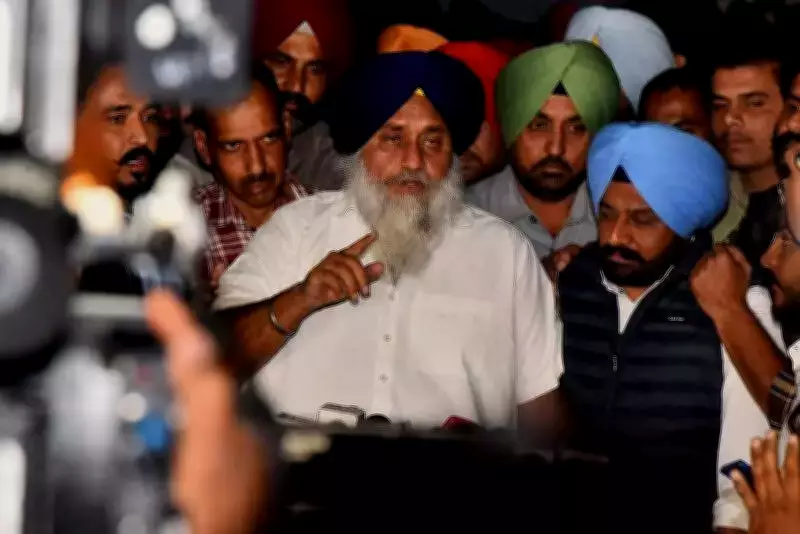
Akali Unity Efforts Face Major Setback as Factions Oppose Badal Leadership
The much-discussed initiative to mend the fractured Akali political house in Punjab has encountered significant resistance, with both the Shiromani Akali Dal (Reorganised) and Shiromani Akali Dal (Waris Punjab De) clearly distancing themselves from any grand unity proposal. This development follows recent suggestions by Bikram Singh Majithia, a prominent leader of the Sukhbir Badal-led Shiromani Akali Dal, who floated the idea of reconciliation after his release from Nabha jail.
Clear Message: Unity Possible, But Not Under Badal Stewardship
The unified message emerging from both dissident factions is unequivocal: while unity might be theoretically possible, it cannot happen under the leadership of Sukhbir Singh Badal. This condition presents what political observers are calling the "silver lining" in the otherwise stalled negotiations—a potential path forward exists, but only if one very prominent name is completely removed from consideration.
Both factions have squarely placed blame on the Badal-led party for several controversial incidents that continue to shape Punjab's political landscape. They specifically point to the police firing episodes at Kotkapura and Behbal Kalan, events that remain deeply embedded in the state's collective memory. Additionally, they highlight the contentious pardon granted to Gurmeet Ram Rahim, the chief of Dera Sacha Sauda, in the 2007 blasphemy case—a decision that triggered widespread public outrage across Punjab.

Non-Negotiable Conditions for Reconciliation
Advocate Iman Singh Khara, spokesperson for Khadoor Sahib MP Amritpal Singh-led SAD (Waris Punjab De), articulated the faction's firm position. "We cannot even contemplate unity with a party responsible for the Behbal Kalan and Kotkapura firing incidents and the granting of pardon to Gurmeet Ram Rahim," he stated emphatically. "These actions, along with other violations of Akal Takht directives, make reconciliation impossible under current leadership."
Khara further emphasized that these conditions are absolutely non-negotiable for his faction. He also claimed there exists "immense respect and wanting" for Amritpal Singh across Punjab, suggesting that many residents are anticipating the 2027 assembly elections to potentially elevate his party to a dominant position in the state's political hierarchy.
Legitimacy Claims and Competing Narratives
Meanwhile, Jagjit Singh Kohli, chief spokesperson of SAD (Reorganised), presented his faction's perspective on legitimacy. He cited the December 2, 2024 Hukamnama to assert that his group now represents the "real" Shiromani Akali Dal. According to Kohli, by strictly adhering to Akal Takht directives, implementing systematic recruitment drives, appointing official delegates, and electing a legitimate president, his faction has earned its authentic status within the Akali tradition.
This creates an intriguing political paradox: all factions claim to represent the true Shiromani Akali Dal, but they fundamentally disagree about which group actually qualifies as "real." The competing narratives about legitimacy and tradition have become central to the unity impasse.
Broader Political Implications and BJP's Strategic Calculations
Political corridors are buzzing with speculation about potential external influences on these developments. Analysts suggest the Bharatiya Janata Party (BJP) might quietly favor a restructured Shiromani Akali Dal that excludes popular Akali faces, particularly since the party currently lacks the strength to secure a majority of seats independently in Punjab. Supporting an alternative Shiromani Akali Dal could serve the BJP's strategic interests in the state.
Political thinker Purshotam Ajnala reflected on the fluid nature of political alliances, noting, "As the saying goes, in politics, yesterday's adversary can be tomorrow's indispensable ally." He emphasized that "a strong Shiromani Akali Dal in Punjab is essential for Punjab, Punjabi identity, and Punjabiyat," adding that it will soon become evident which Akali leader ultimately emerges to guide the state forward.

The current standoff reveals deep-seated divisions within Punjab's Akali politics, with historical grievances, leadership disputes, and competing claims of legitimacy creating substantial barriers to any immediate reconciliation. While the theoretical possibility of unity remains, the practical requirements—particularly regarding leadership—appear insurmountable under present circumstances.





