An eighth-century king has made a dramatic return to the political arena in Tamil Nadu, more than 1,300 years after his reign. Perumbidigu Mutharaiyar (705–745 CE), a ruler from the Mutharaiyar dynasty that once dominated central Tamil Nadu, is now at the centre of a modern-day political contest. The trigger was the recent release of a commemorative postage stamp in his honour, an event that has seen the Bharatiya Janata Party (BJP) and the Dravida Munnetra Kazhagam (DMK) scrambling to claim credit.
The Stamp That Sparked a Political Row
The release of the postage stamp honouring the ancient king has opened a new front in Tamil Nadu's political battleground. The BJP has projected the stamp as an initiative of the Union government, highlighting its commitment to Tamil heritage. Prime Minister Narendra Modi, in a social media post on the day of the release, described King Mutharaiyar as a formidable administrator known for his vision and commitment to justice.
However, the ruling DMK in the state has countered this narrative. The party maintains that the long-pending demand was fulfilled only after the intervention of the state government. Backward Classes Welfare Minister Siva V Meyyanathan, who belongs to the Mutharaiyar community, wrote to Union Parliamentary Affairs Minister Kiren Rijiju on November 13, seeking the stamp's release. Soon after the stamp was issued, posters thanking Chief Minister M K Stalin appeared in Trichy and neighbouring districts.

Electoral Calculations Behind the Historical Tribute
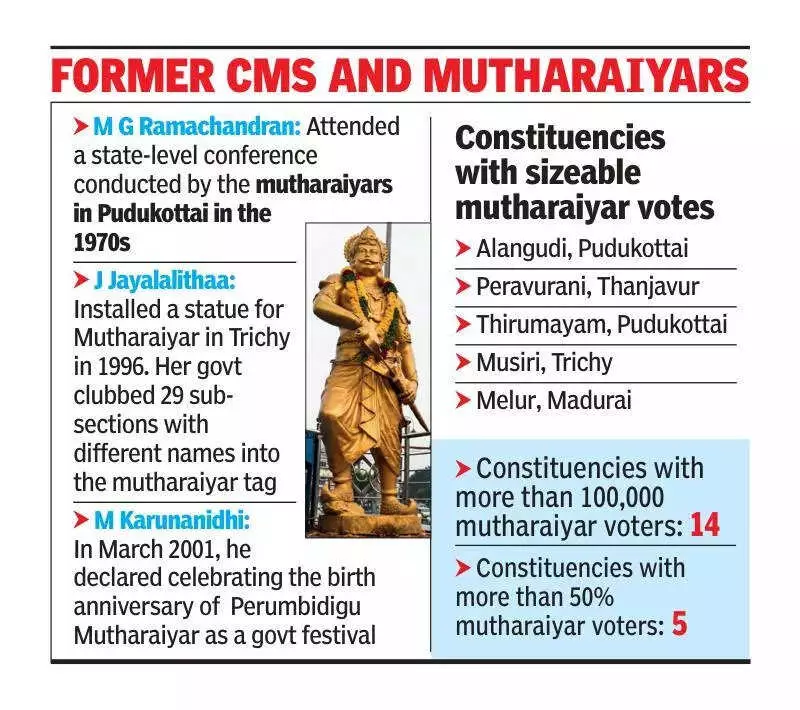
The sudden focus on a medieval king is not merely academic; it is driven by hard electoral math. The Mutharaiyars are a numerically significant agrarian community concentrated in the central districts of Tamil Nadu. According to the Mutharaiyar Ezhuchi Sangam, the community accounts for about 35% of the electorate in nearly 20 assembly constituencies across Pudukottai, Thanjavur, Karur, and Trichy districts. The Sangam, citing a 2021 survey, states that the community forms over 50% of voters in at least five segments.
S Panneerselvam, honorary president of the Sangam, noted that the community was historically inclined towards the AIADMK due to its emotional attachment to party founder and former chief minister M G Ramachandran. However, voting patterns have diversified over the years. For instance, in the Manachanallur constituency, where the Mutharaiyar population is estimated at over one lakh, DMK's S Kathiravan from the Reddiar community won despite the Mutharaiyars being the dominant group.
Community's Perspective and Past Recognitions
Amid the political crossfire, the Araiyar Suvaran Maran Pidari Trust based in Trichy offered a different take. M Chandrasekaran, the managing trustee, stated that the stamp was the result of a community-driven effort. "Our trust paid Rs 7.3 lakh to the postal department for the stamp. The Union government expedited the process," he clarified.
Political parties have a history of engaging with the community. Leaders and their contributions include:
- M G Ramachandran: Attended a state-level conference by the Mutharaiyars in Pudukottai in the 1970s and assured support.
- J Jayalalithaa: Installed a statue for Mutharaiyar in Trichy in February 1996. Her government also clubbed 29 sub-sections into the common Mutharaiyar tag.
- M Karunanidhi: In March 2001, his government declared celebrating the birth anniversary of Emperor Perumbidigu Mutharaiyar in Trichy as a government festival.
Recently, DMK functionaries have pointed to the induction of Minister Meyyanathan into the cabinet and the unveiling of a life-size statue of Perumbidigu Mutharaiyar in Madurai in 2022 by Deputy Chief Minister Udhayanidhi Stalin as evidence of their commitment.
The battle for the support of this pivotal community is only expected to intensify in the lead-up to future elections. With both national and regional parties keenly aware of the Mutharaiyar vote bank's power, the legacy of an eighth-century king continues to shape twenty-first-century politics in Tamil Nadu.